 Serengeti Safari Packages
The Best Time to Visit Serengeti National Park
The best time to visit Serengeti comes down to rain, herds and fees. The park runs a dry season from June to October, short rains in November and December, a dry spell in January and February and the long rains from March to May. Fees change with the season too, so the month you pick changes what you pay at the gate and what a package costs. This page lays out the seasons, the weather month by month, the crowds and the low and high season prices. For the herd positions in detail, see the guide to the Great Migration Serengeti, and for the park itself see Serengeti National Park. All figures below come from the sources named with each fact. The bookable trips are compared on Serengeti safari packages compared.
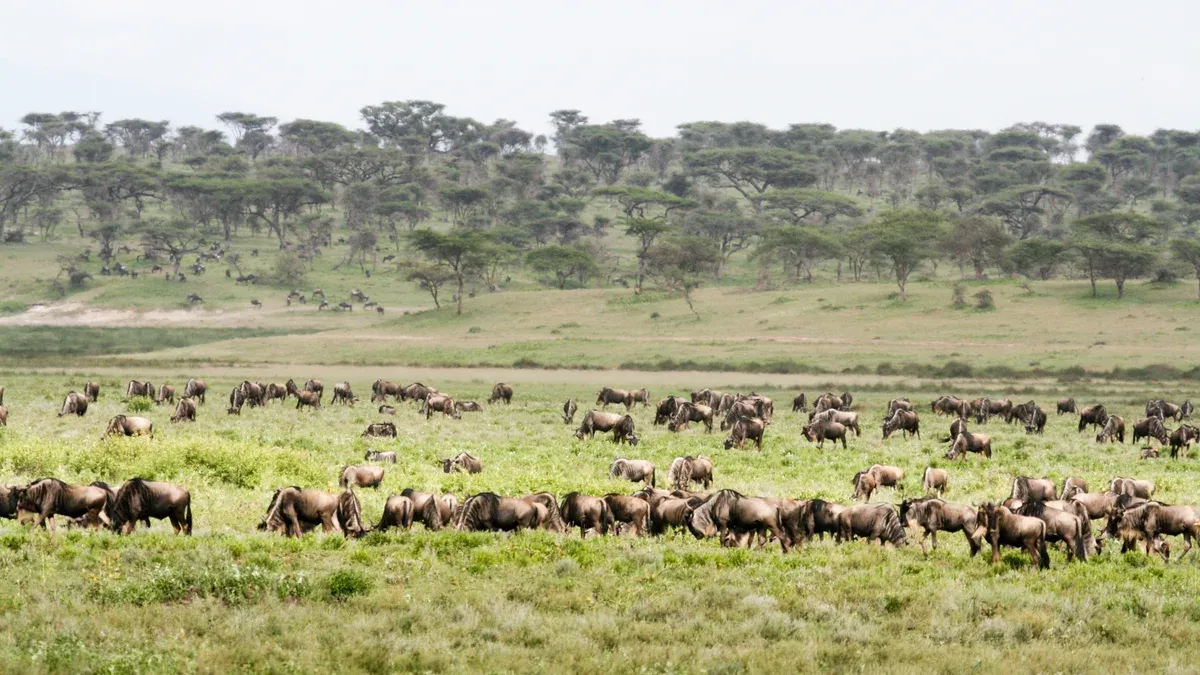
Wildebeest on the plains near Ndutu. Photo: Christoph Strässler from Oberdorf BL, Schweiz, CC BY-SA 2.0, via Wikimedia Commons
Quick answer The short answer
The best time to visit Serengeti is the dry season from June to October, when July rain averages just 10 mm in Arusha and game viewing is at its best. January and February are the second window, a dry spell that matches the calving season. The long rains of March to May bring the low-season fee from 15 March and, per Africa Geographic, the lowest lodge prices and fewest vehicles in April. Prices for packages range from $770 per person for a 3-day camping safari upward.
Key takeaways
- June to October is the dry season, with daytime highs around 26 °C and chilly mornings. See the 5-Day Serengeti Camping Safari for a dry-season itinerary.
- January and February are a dry spell and the calving window. The 8-Day Serengeti Migration Safari puts you in the northern Serengeti for the river season.
- For the full seasonal picture, see the homepage section on seasons and weather or the guide to the Great Migration.
The Four Seasons in Short
The Serengeti year splits into a long dry season, the short rains, a dry spell and the long rains. The fee calendar does not match the weather calendar exactly, which is why both appear below.
Dry Season, June to October
SafariBookings says the dry season runs June to October, with daytime averages of about 26 °C and nights around 14 °C. Cold fronts between June and September can bring temperatures close to freezing, and early mornings are usually chilly. Rainfall is low: Arusha, at 1,400 metres elevation on the safari route, averages 30 mm in June, 10 mm in July, 10 mm in August and 20 mm in September per the Weatherbase table cited by Wikipedia. This is also the river crossing season in the north, though no operator can guarantee a crossing because the migration is driven by rainfall.
| Months | Season | Weather | Good for |
|---|---|---|---|
| June to October | Dry season | About 26 °C by day, 14 °C at night, 10 to 30 mm rain a month | Game viewing, Mara River season |
| November to December | Short rains | About 27 °C by day, 100 to 110 mm rain a month | Green landscapes, herds moving south |
| January to February | Dry spell | About 28 °C by day, 50 to 80 mm rain a month | Calving on the Ndutu plains, dry weather |
| March to May | Long rains | 25 to 29 °C by day, heaviest rain in March and April | Low season fees from 15 March, lowest lodge prices and fewest vehicles in April |
Short Rains and Dry Spell, November to February
Roadtrip Africa places the short rains in November and December. SafariBookings says rain in November and December is unlikely to interfere with a safari, and that October short rains may start at the end of the month if they arrive early. January and February are usually a dry spell.
This is the calving window: Wikipedia says calving begins around January to March with about 500,000 calves born in roughly 2 to 3 weeks in February, and Duma Explorer states up to 8,000 wildebeest calves are born per day at peak. Daytime highs reach about 28 °C in Arusha in January and February.
- SafariBookings says November and December rain is unlikely to interfere with a safari.
- February is the heart of calving season on the Ndutu plains.
- The balloon operator flies from Ndutu from 20 December to 31 March and from the Central Serengeti year-round.
Long Rains, March to May
SafariBookings calls March to May the wettest period and says it tends to rain most days, although seldom for the whole day. Arusha averages 170 mm of rain in March, 360 mm in April and 210 mm in May. Africa Geographic says April is the wettest month, with rain on about 20 days and over 100 mm, and has the lowest lodge prices of the year and far fewer vehicles.
It also warns that tall grass reduces visibility in April and that March roads can be muddy, so open vehicles and flexible plans help. The TANAPA tariff defines this as the low season for fees, from 15 March to 15 May.
- Africa Geographic says March roads can be muddy, so open vehicles and flexible plans help.
- April has the lowest lodge prices of the year per Africa Geographic.
- Africa Geographic says tall grass reduces visibility in April.
Sources: SafariBookings, Weatherbase via Wikipedia, Africa Geographic, TANAPA tariff
Month by Month
The table below puts all twelve months side by side, using Arusha average rainfall from the Weatherbase table cited by Wikipedia, temperature ranges from SafariBookings and Africa Geographic, and herd positions from Duma Explorer and African Overland Tours. The herd line is a summary only, it moves with the rain, and the full month-by-month detail lives on the Great Migration page.
Every Month Compared
Rainfall figures are Arusha averages at 1,400 metres, not Serengeti readings. Crowds and fees follow the TANAPA tariff, which sets the conservation fee peak at 16 May to 14 March and the low season at 15 March to 15 May, and the concession fee peak at July to September. Read the fee section below for the exact numbers and the conflicting VAT-inclusive versions.
| Month | Rain | Where to be | Crowds and fees |
|---|---|---|---|
| January | 50 mm in Arusha, a dry spell per SafariBookings | Southern Serengeti and Ndutu plains, calving begins | Peak conservation fee of US $70 applies, and Roadtrip Africa says December to January queues add about 30 minutes at the gates |
| February | 80 mm in Arusha | Ndutu plains, about 500,000 calves born in 2 to 3 weeks | Peak fee of $70, days are warm at about 28 °C |
| March | 170 mm in Arusha | Herds still south, then moving north through the Seronera Valley as the long rains start | Low fee of $60 applies from 15 March, roads can be muddy per Africa Geographic |
| April | 360 mm in Arusha, the wettest month | Central Serengeti and the Western Corridor as herds move north | Low season $60 fee, lowest lodge prices and far fewer vehicles per Africa Geographic |
| May | 210 mm in Arusha | Central and western regions with the herds | Low fee of $60 until 15 May, then peak $70 from 16 May |
| June | 30 mm in Arusha, dry season starts | Western Serengeti, Grumeti River crossings from June to July | Peak fee of $70 |
| July | 10 mm in Arusha, level with August as the driest month | Grumeti River, then first Mara River arrivals, northern lodges need advance booking | Peak $70 fee and peak concession fee of $60 a night, about 30 minutes of gate queues |
| August | 10 mm in Arusha | Kogatende and the Mara River, peak crossing month | Peak fees, northern lodges can fill up to a year ahead per Africa Geographic |
| September | 20 mm in Arusha | Northern Serengeti and the Mara River, crossings from July to September or October depending on the source | Peak $70 fee, still high season |
| October | 30 mm in Arusha, short rains may start late | Herds turn south from late October, vehicle numbers ease and prices soften slightly | Peak $70 conservation fee still applies, concession fee drops to $50 a night |
| November | 110 mm in Arusha | Herds split, some east and some south, last Mara crossings may occur in early November | Short rains, peak $70 conservation fee still applies |
| December | 100 mm in Arusha | Herds return to the southern Serengeti and Ndutu region | Prices moderate and rise toward the holidays per Africa Geographic |
What the Weather Feels Like
SafariBookings gives daytime highs in the Serengeti averaging about 27 °C (81 °F) with chilly nights. Africa Geographic gives 25 to 29 °C from March to May and 25 to 28 °C from June to October. Nights cool sharply, and cold fronts between June and September can push temperatures close to freezing, so pack layers.
The full kit list is on the safari packing list page. Arusha mean daily minimums sit at 8 °C in June, August and September and 13 °C in April, which gives a sense of how cold early game drives feel on the same circuit.
- Daytime: about 26 to 28 °C year-round, so light clothing works by day.
- Nights: chilly in the dry season, close to freezing on cold fronts.
- Rain: heaviest in April, lightest in July and August.
Sources: Weatherbase via Wikipedia, SafariBookings climate, Africa Geographic, Duma Explorer, African Overland Tours
The Best Time for Tanzania Safari: Altezza Travel
A walkthrough of the Tanzania safari seasons and what each part of the year offers. Third-party video by Altezza Travel. This site did not shoot it and has no relationship with the creator.
Low Season, High Season and the Price
When you go changes three things: the park fee at the gate, the nightly concession and campsite fees, and the price of the package itself. The fee sources disagree on whether VAT is included, so both versions are given here.
The Fee Calendar and the Conflict
The TANAPA tariff for the latest published season sets the Serengeti conservation fee for non-East African adults aged 16 and over at US $70 per day in peak season and US $60 per day in low season, and states all charges are VAT (18%) exclusive. It defines peak as 16 May to 14 March and low season as 15 March to 15 May. Children aged 5 to 15 pay US $20 per day in both seasons and children under 5 are free.
Other sources fold VAT in and get higher totals: Duma Explorer lists Serengeti entry at $82.60 for adults in high season and $70.80 in low season including 18% VAT, and SafariFind lists $83 per adult per 24 hours and $24 for children with VAT included. The concession fee shows the same split, US $60 per person per night in July to September and US $50 from October to June under the tariff, against $71 per adult per night for foreign non-residents at Duma Explorer. Ask your operator which figure applies, because a listing that includes fees will have priced one of these in.
Note that the tariff states fees once paid are non-refundable, and SafariFind says entry fees are a single 24-hour permit with no refunds for shortened stays.
| Fee | TANAPA tariff (VAT exclusive) | VAT-inclusive versions |
|---|---|---|
| Adult conservation fee, peak | US $70 per day, 16 May to 14 March | $82.60 (Duma Explorer) or $83 per 24 hours (SafariFind) |
| Adult conservation fee, low | US $60 per day, 15 March to 15 May | $70.80 (Duma Explorer) |
| Child 5 to 15 | US $20 per day, both seasons | $23.60 high, $11.80 low (Duma Explorer) |
| Concession per adult night | US $60 July to September, $50 October to June | $71 (Duma Explorer) |
| Public campsite per adult night | US $30 in parks, $60 special and seasonal Serengeti sites in July to September | $35.40 public (Duma Explorer and NCAA) |
What a Trip Costs by Season
Market ranges come from the operators' guides, not from this site. SafariFind gives Tanzania safari costs of $250 to $1,500+ per person per day, with budget safaris at $250 to $400, mid-range at $450 to $800 and luxury at $850 to $1,500+. Duma Explorer gives similar budget camping joins at $250 to $400 per day and adds ultra-luxury fly-in trips at $1,500 to $2,500+.
SafariFind says costs usually exclude international flights, insurance, visas, alcohol and tips. Going in the long rains puts you in the fee low season and, per Africa Geographic, the lowest lodge prices of the year. Peak months cost more on several lines: the concession fee jumps in July to September, and northern lodges can fill up to a year ahead.
- Budget camping: $250 to $400 per person per day (SafariFind and Duma Explorer).
- Mid-range lodge: $450 to $800 per person per day (both sources).
- Luxury: $850 to $1,500+ per person per day (both sources).
Packages by Month
Camping packages are the cheapest trips in the catalog. The pick for the shoulder and dry months on a budget is the 3-Day Serengeti Big Five Safari at $900 per person, which includes all park fees, entry, transit, concession, camping and the crater service fee. For the long rains, the 5-Day Serengeti Camping Safari at $1,320 per person lists 'All Fees and Taxes' as included and adds a full Tarangire day.
For the dry season river window, the 8-Day Serengeti Migration Safari at $4,257 per person includes park fees and all taxes and VAT and puts you in the northern Serengeti, though no listing can promise a crossing, because the migration moves with the rain. If a listing does not state whether park fees are in the price, ask before you book, and check the full fee breakdown in the homepage section on park and crater fees.
- 3-day camping from Arusha: $770 per person, park fees not stated, so ask.
- 3-day camping with fees included: $900 per person.
- 5-day camping with fees and taxes: $1,320 per person.
- 8-day migration, private, fees and VAT included: $4,257 per person.
Sources: TANAPA tariff, Duma Explorer, SafariFind, SafariFind costs, Africa Geographic
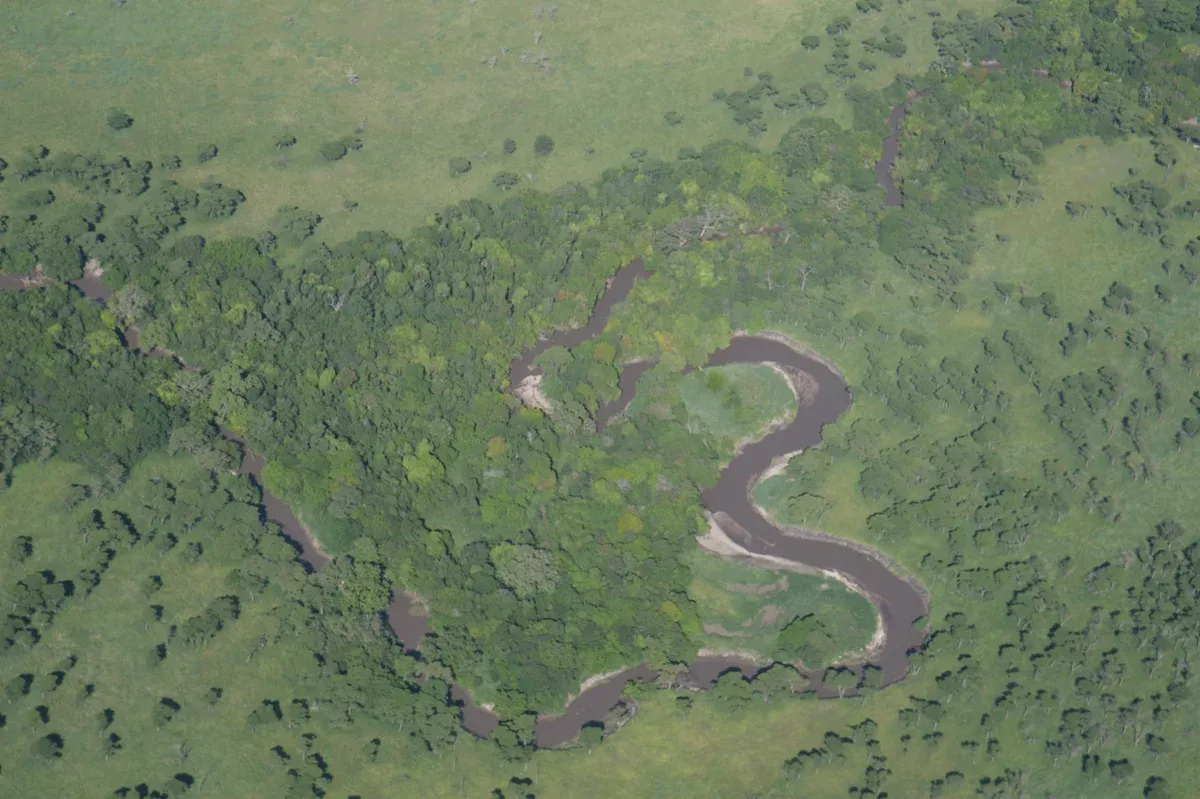
The Grumeti River winding through woodland, seen from above. Photo: Calle v H, CC BY 2.0, via Wikimedia Commons
Season Tips
Do
- Do travel in June to October if game viewing is the goal, because SafariBookings says the dry season averages 26 °C by day with little rain and Roadtrip Africa names June to October among the best months.
- Do consider January and February, because Roadtrip Africa names them best months and roughly 500,000 calves are born in about 2 to 3 weeks in February.
- Do book northern Serengeti lodges far ahead for July and August, because Africa Geographic says August lodges can fill up to a year ahead.
- Do accept the low season for a tighter budget, because April has the lowest lodge prices of the year and far fewer vehicles per Africa Geographic, and the $60 low-season fee applies until 15 May.
- Do pack for cold mornings in the dry season, because cold fronts between June and September can bring temperatures close to freezing.
Don't
- Don't assume the wet season ruins a safari, because SafariBookings says March to May rain seldom lasts the whole day and November and December rain is unlikely to interfere.
- Don't book a river crossing trip expecting a guarantee, because Duma Explorer says no operator can guarantee a crossing and animals may wait days.
- Don't plan tight timings in peak months, because Roadtrip Africa says peak queues add about 30 minutes at the Ngorongoro gate and about 30 minutes at the Serengeti gate.
- Don't expect a fee refund for a shortened stay, because the tariff says fees once paid are non-refundable and SafariFind says the entry fee is a single 24-hour permit.
Best Time to Visit Serengeti FAQ
What is the best month for safari in Tanzania's Serengeti?
Roadtrip Africa names January to February and June to October as the best months to visit, with the dry season offering the easiest game viewing and the early year offering calving season on the Ndutu plains. Compare months on the best time to visit Serengeti table above.
How many days do I need in Serengeti National Park?
The shortest packages in the catalog run 3 days from Arusha and cover the Serengeti and Ngorongoro, while 5-day itineraries add a full Tarangire day, and migration trips run 6 to 10 days to reach the northern river areas. See the 5-Day Serengeti Camping Safari for a mid-length example.
When is the Serengeti calving season?
Wikipedia says calving begins around January to March with about 500,000 calves born in roughly 2 to 3 weeks in February, and the herds gather on the southern plains. The area guide to Ndutu covers the calving grounds.
When are the Mara River crossings?
Duma Explorer gives July to September and African Overland Tours gives July to October, and the timing shifts each year because the migration is driven by rainfall. The full herd calendar is on the Great Migration page.
Is the rainy season a bad time to go?
Not necessarily. SafariBookings says the long rains seldom last the whole day and the November and December rain is unlikely to interfere with a safari, and Africa Geographic notes April has the lowest lodge prices and far fewer vehicles. Budget travelers can look at a 3-day camping safari at $770 per person, the lowest price in the catalog.
How much do park fees change between low and high season?
The TANAPA tariff charges non-East African adults US $70 per day in peak season and $60 in low season, VAT exclusive, with the low window at 15 March to 15 May. VAT-inclusive totals of $82.60 and $70.80 appear on Duma Explorer. The full breakdown with sources is on the homepage fee section.