 Serengeti Safari Packages
Tarangire National Park
Tarangire National Park is the first park on many northern Tanzania safaris, about 120 km from Arusha, and it is known for big dry-season elephant herds and its baobabs. This guide covers the park itself, the Tarangire River and the Silale Swamp, the dry-season gathering of animals, the entry fees with their VAT note, and the bookable safari packages that spend a day here. Prices shown are the card prices on this site's tour pages, and every figure comes from the sources named in each section. The bookable trips are compared on all Serengeti safari packages.
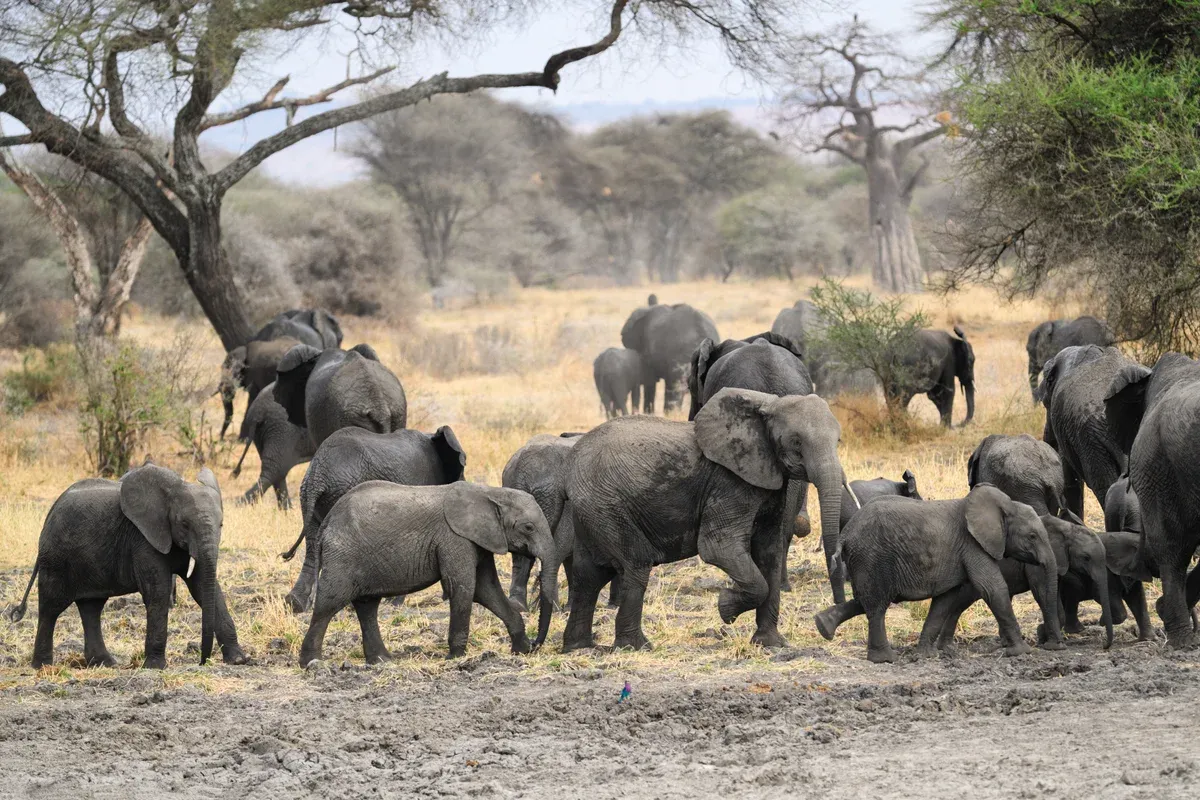
Elephants at a waterhole in Tarangire National Park. Photo: Eric Kilby, CC BY-SA 2.0, via Wikimedia Commons
Quick answer Tarangire in short
Tarangire National Park is a TANAPA-managed park in the Manyara Region about 120 km from Arusha. It is known for dry-season elephant herds of up to 300 animals, a high density of elephants, baobab woodland and more than 550 bird species. Entry for a non-East African adult costs $50 per day in peak season and $45 in low season, VAT excluded. July to November is the best window, when the Tarangire River is the only drinking water for miles.
Key takeaways
- See how a full Tarangire day fits a wider circuit in the 5-Day Serengeti Camping Safari at $1,320 per person, which lists all fees and taxes as included.
- Prefer beds over tents? The 4-Day Serengeti Mid-Range Safari at $1,750 per person spends its first night near Tarangire at Suricata Boma Lodge.
- Check the entry fees, seasons and the night game drive price in the fees and packages section.
- Planning the whole northern circuit? The homepage comparison of Serengeti safari packages shows every tour side by side.
What Tarangire Is
Tarangire National Park is governed by TANAPA as an IUCN Category II park. The figures below come from Wikipedia, SafariBookings and Journeys by Design, and where sources disagree both are given.
The Park at a Glance
Tarangire lies in the Manyara Region and is run by TANAPA, Tanzania's national parks authority. Its vegetation is Acacia and Combretum woodland, seasonally flooded grassland, granitic ridges and swamps. Wikipedia records 161,792 visitors to the park in 2012, and the park has been a Lion Conservation Unit since 2005.
The park sits about 120 km from Arusha according to Journeys by Design. Wikipedia places it about 70 km from Lake Manyara National Park, so the two combine easily on a single route. If you want the neighbouring lake in depth, see the guide to Lake Manyara National Park.
| Fact | Figure | Source |
|---|---|---|
| Distance from Arusha | 120 km | Journeys by Design |
| Distance from Lake Manyara National Park | about 70 km | Wikipedia |
| Altitude | 985 to 1,528 m (3,232 to 5,013 ft) | SafariBookings |
| Bird species | more than 550 | Wikipedia, Easy Travel Tanzania |
| Visitors in 2012 | 161,792 | Wikipedia |
| Lion Conservation Unit | since 2005 | Wikipedia |
| Expert rating | 3.8 out of 5 from 13 reviews | SafariBookings |
| User rating | 4.6 from 408 reviews | SafariBookings |
The River, the Swamps and the Baobabs
The Tarangire River gives the park its name and its dry-season drama. Wikipedia says the river rises in the Irangi Hills and escarpment of Babati and Kondoa districts and ends at Lake Burunge. In the dry season its flow drops to about 0.005 m³/s and long stretches of the riverbed run dry, with mean annual rainfall of just 656 mm. SafariBookings calls the river the only source of drinking water for miles around in the dry season, which is exactly why the animals concentrate along it.
The south of the park is, in SafariBookings' words, a vast seasonal swamp network. The best known is the Silale Swamp, which Easy Travel Tanzania places in the southwestern part of the park and describes as a birdwatching highlight, including the kori bustard. Simba Paka Safaris calls the Silale Swamp a permanent water source that draws wildlife from a wide area, with good viewing through September.
Then there are the baobabs. Wikipedia says large baobab species such as Adansonia digitata reach 25 to 30 m in height and that African baobabs can store up to 120,000 litres of water in the trunk. Trunk rings are not annual, so baobab ages are estimated by radiocarbon dating rather than counted.
Sources: Wikipedia, Tarangire National Park, SafariBookings, Journeys by Design, Easy Travel Tanzania, Simba Paka Safaris
Elephants and the Rest
Tarangire's wildlife story is written by water. In the dry months the river and the swamps draw the animals in.
The Dry-Season Gathering
Elephants are the headline. SafariBookings reports dry-season herds of up to 300 elephants that dig for water in dry riverbeds, and says elephants are most abundant from July to November. Wikipedia records a high density of elephants in the park and notes that the oldest known elephant to give birth to twins was recorded here. TAWIRI, the Tanzania Wildlife Research Institute, runs a long-term elephant study in the park and has monitored 29 families of the northern Tarangire sub-population, with 55 births recorded.
The sources agree on the pattern: in the dry season the animals come to the river, and Journeys by Design confirms herds of up to 300 elephants come to the water.
Beyond elephants, SafariBookings says the lion is the only big cat regularly seen in Tarangire, and that dwarf mongoose colonies live in abandoned termite mounds. Simba Paka Safaris adds that wildlife is most visible through September, when the grass is thin and short after the long rains, and that the park turns green again in early June before water becomes scarcer by late June.
Birders have the strongest numbers of all: more than 550 bird species, resident and migratory, per Wikipedia and Easy Travel Tanzania. For comparison, the Serengeti animals guide covers a park with more than 500 bird species.
Tsetse Flies in the Woodland
What the tsetse fly can transmit, which colours attract it and how to treat a bite are covered in depth in the dedicated tsetse fly guide.
Tarangire: A Top Tanzania Safari Experience: Altezza Travel
Tarangire's elephants, baobabs and game drives. Third-party video by Altezza Travel. This site did not shoot it and has no relationship with the creator.
Fees, Season and the Packages That Stop Here
Tarangire's fees come from the TANAPA tariff read on the Kabira Uganda Safaris copy of the official fee schedule. All charges are VAT (18%) exclusive, fees are non-refundable once paid, proof of identification is mandatory at the entry gate, and conservation and vehicle fees cover multiple entry.
Entry and Activity Fees
The tariff sets the Tarangire conservation fee for non-East African adults at $50 per day in peak season and $45 in low season. Children aged 5 to 15 pay $15 per day. If you stay inside the park overnight, the hotel concession fee at Tarangire is $40 per adult per night and $10 per child. Night game drives are offered at Tarangire under the tariff at $50 per adult and $25 per child aged 5 to 15, which the Serengeti does not list. Duma Explorer, a second source, lists Tarangire entry at $59 for adults in high season and $53.10 in low season, figures that appear to include VAT, so ask your operator which basis it quotes.
The tariff document read here is the latest one found online. No newer official tariff could be confirmed, so treat these as the latest published figures and expect the operator's invoice to show VAT on top.
| Fee | Amount | Source |
|---|---|---|
| Adult conservation fee, peak season | $50 per day, VAT exclusive | TANAPA tariff |
| Adult conservation fee, low season | $45 per day, VAT exclusive | TANAPA tariff |
| Child 5 to 15 conservation fee | $15 per day, VAT exclusive | TANAPA tariff |
| Hotel concession fee | $40 per adult per night, $10 per child | TANAPA tariff |
| Night game drive | $50 adult, $25 child 5 to 15 | TANAPA tariff |
| Alternative adult entry, VAT included | $59 high season, $53.10 low season | Duma Explorer |
When to Go
SafariBookings says the best time for Tarangire is July to November, the high season runs June to October, and the wet season runs November to May with short rains in November and December. That matches the wildlife pattern: elephants are most abundant from July to November and viewing is sharpest through September when the grass is short. Simba Paka Safaris says July is when high season begins and the park is green after the long rains in early June.
In practice, the dry-season window is when the Tarangire River earns its role as the only drinking water for miles. For how this window fits the wider year across the north, see the guide to the best time to visit Serengeti, which covers the same rain calendar.
The Packages That Open With Tarangire
Several bookable itineraries in this site's catalog use Tarangire as the first park on the northern circuit. The 5-Day Serengeti Camping Safari costs $1,320 per person, has 319 reviews with a 5 rating, and adds a full Tarangire day before the Serengeti and the crater, with all fees and taxes listed as included and a free Arusha hotel night before and after.
For lodge beds, the 4-Day Serengeti Mid-Range Safari costs $1,750 per person and has its first night at Suricata Boma Lodge near Tarangire. Note that this listing does not state whether park fees are in the price, so ask the operator before you book.
Longer trips also open here. The 8-Day Serengeti Migration Safari at $4,257 per person includes Tarangire, Lake Manyara, the Serengeti and the crater with park fees and taxes listed as included, and the Mara River Crossing Safari at $3,763 per person has Tarangire plus three nights of mobile camps that follow the migration, with park entrance fees listed as included. Night game drives, where offered, are a separate tariff item at $50 per adult and are not named in any of these itineraries.
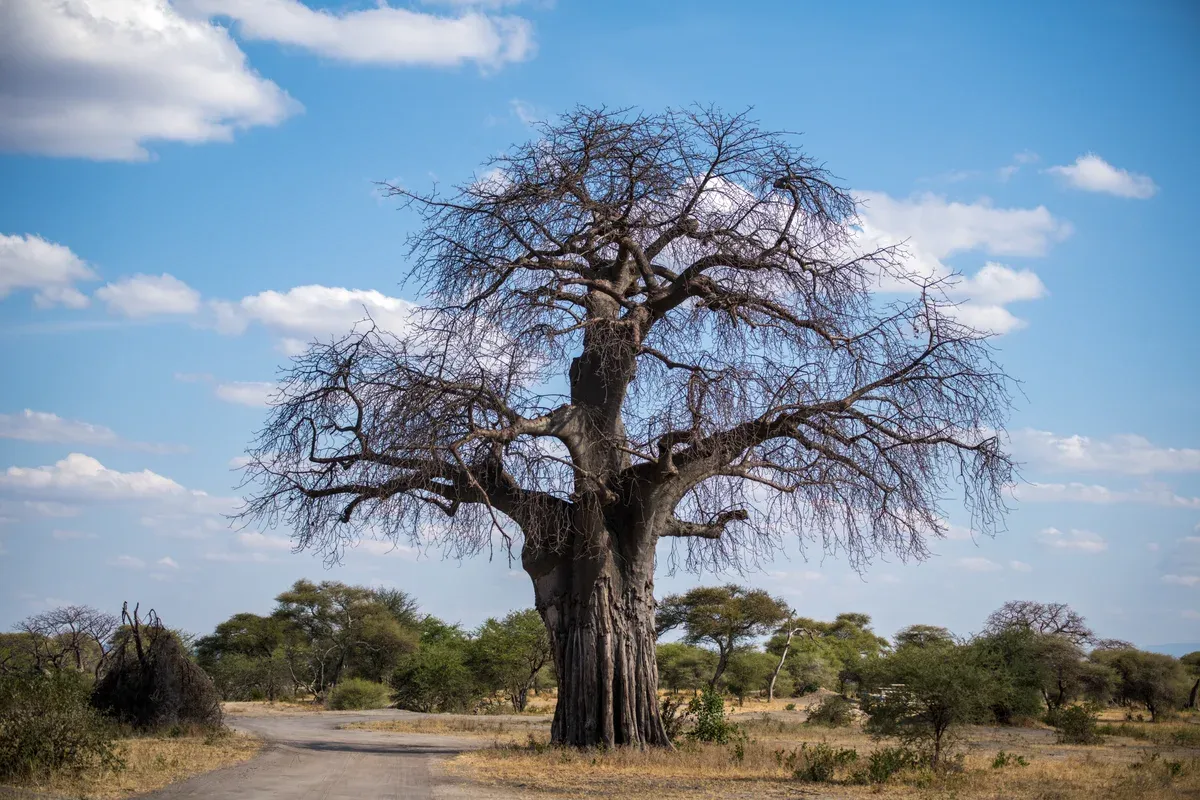
A baobab beside the track in Tarangire National Park. Photo: Jorge Láscar from Melbourne, Australia, CC BY 2.0, via Wikimedia Commons
Dos and Don'ts in Tarangire
Do
- Do visit between July and November, because SafariBookings names this the best window and elephants are most abundant then, with herds of up to 300 at the river.
- Do carry your passport or ID to the gate, because the TANAPA tariff states proof of identification is mandatory at entry.
- Do budget the concession fee if you sleep in the park, because the tariff adds $40 per adult per night at Tarangire on top of the daily conservation fee.
- Do ask a night game drive, because Tarangire is one of the parks where the tariff lists one, at $50 per adult and $25 per child aged 5 to 15.
- Do bring binoculars for the Silale Swamp, because Easy Travel Tanzania names it a birdwatching highlight with more than 550 species in the park to find.
Don't
- Don't expect the fee at the gate to match the tariff exactly on your invoice, because all tariff charges are VAT (18%) exclusive and operators pass that tax on.
- Don't count on leopards or cheetahs, because SafariBookings says the lion is the only big cat regularly seen in Tarangire.
- Don't expect the dry-season elephant gathering in the wet season, because the wet season runs November to May and SafariBookings names July to November as the best window.
- Don't assume the entry fee is refundable, because the tariff states fees once paid are non-refundable.
Tarangire FAQ
Is Tarangire worth it?
For elephants and birds, yes. SafariBookings reports dry-season herds of up to 300 elephants, Wikipedia records a high density of elephants, and the park lists more than 550 bird species, all within about 120 km of Arusha. Its user rating of 4.6 from 408 reviews on SafariBookings backs that up. See which tours include it in the packages section.
How far is Tarangire from Arusha?
Journeys by Design puts Tarangire National Park 120 km from Arusha, and Wikipedia places it about 70 km from Lake Manyara National Park, which is why several northern circuit safaris in this catalog open with a Tarangire day. The 5-Day Serengeti Camping Safari uses it exactly that way.
What are the entry fees for Tarangire?
The TANAPA tariff sets $50 per day for non-East African adults in peak season and $45 in low season, children 5 to 15 pay $15, and all charges are VAT (18%) exclusive. Duma Explorer quotes $59 high and $53.10 low including VAT. The full breakdown with sources is in the fees table.
When is the best time to visit Tarangire?
SafariBookings says July to November is best, the high season runs June to October, and the wet season runs November to May. In the dry months the Tarangire River becomes the only drinking water for miles and elephants are most abundant, with wildlife most visible through September when the grass is short.
Which animals will I see in Tarangire?
Elephant herds of up to 300, lions, which SafariBookings calls the only big cat regularly seen, dwarf mongoose in abandoned termite mounds and more than 550 bird species including the kori bustard at the Silale Swamp. No sighting can be promised on any given drive. For the wider north, compare with the Serengeti animals guide.
Which safari packages include Tarangire?
In this catalog, the $1,320 5-Day Serengeti Camping Safari, the $1,750 4-Day Serengeti Mid-Range Safari and the $4,257 8-Day Serengeti Migration Safari all list Tarangire National Park in their itineraries, and the shorter 3-day tours do not. Check the fee status of each listing before booking, since one of them does not state whether park fees are included.