 Serengeti Safari Packages
Safari Clothes for Women
Safari clothes for women on a Tanzania circuit come down to a short list: neutral trousers, shirts with sleeves, a fleece, closed shoes and a hat with a strap. Mornings on an open vehicle can sit below 10°C (50°F) while midday reaches about 30°C (86°F), so layers do the work. This page walks through a full outfit list for game drives, evenings in lodges and camps, modest dress for Maasai villages and Zanzibar, shoes, period care in camp and laundry reality. It ties each choice to the places you will actually drive: dusty plains, the cold Ngorongoro rim and wooded tsetse country near Tarangire National Park. For the wider kit, see the safari packing list, and for a full comparison of Serengeti safaris, start at the homepage.
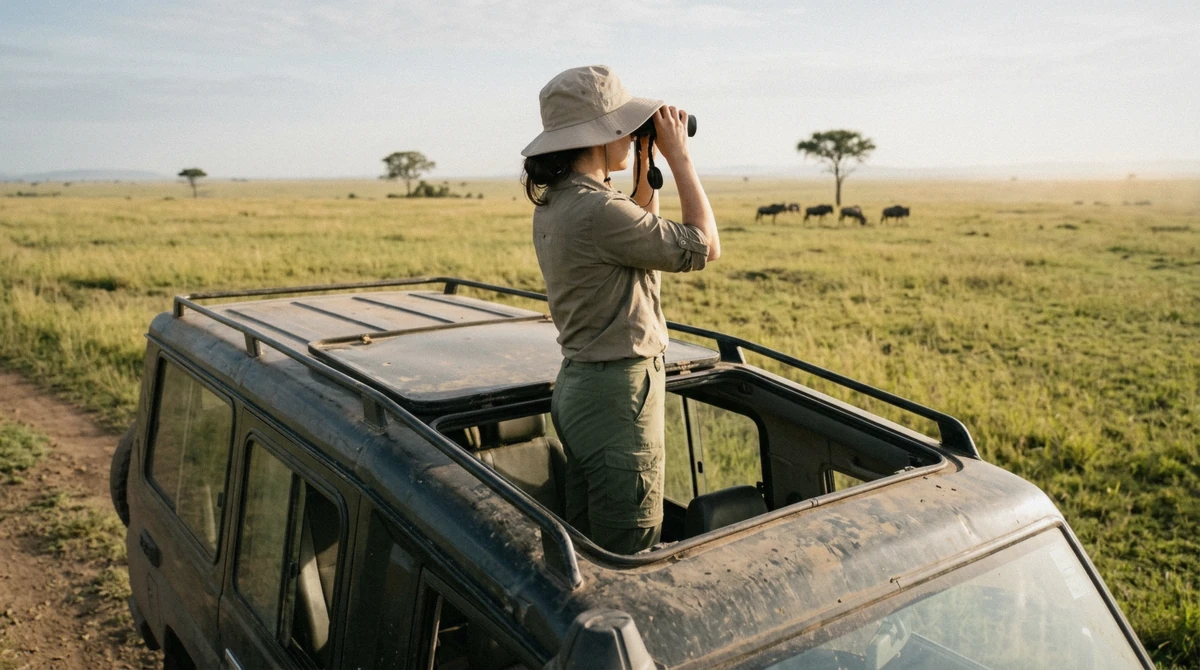
What a woman typically wears on a Serengeti game drive.
Quick answer The short answer
Plan 3 to 5 mix-and-match safari outfits for women in khaki, olive or beige, because most lodges offer laundry and publishers such as Foot Slopes Tours suggest roughly 3 to 5 outfits for the whole trip. Skip blue and black, which attract tsetse flies, and skip white, which shows dust. Bring one warm layer for the Ngorongoro rim, where nights often drop below 10°C (50°F). Add closed shoes, a brimmed hat with a strap and enough underwear for the trip, since some camps do not wash it.
Key takeaways
- Build the core list item by item in The Core Safari Outfit for Women below.
- A 4-Day Serengeti Mid-Range Safari at $1,750 per person sleeps you in lodges, so a dinner dress and sandals earn their place.
- A 3-Day Serengeti Camping Safari at $770 per person means cold tent nights, so long pyjamas and a beanie matter.
- Village and coast rules are covered in Villages, Zanzibar and Ramadan.
The Core Safari Outfit for Women
This is the working list for 5 days on the northern circuit, built from what Tanzania publishers and the CDC actually advise.
The Item-by-item List
The quantities below follow the publishers who say most lodges and camps run same-day or next-day laundry, so a small wardrobe washes as you go. Foot Slopes Tours tells women to plan roughly 3 to 5 outfits that mix and layer. Tanzania Specialist says 3 to 4 outfits can cover a two-week trip because washing is hand-washed and line-dried. Underwear is the exception: Travelpander advises packing enough for the whole trip because some camps will not wash it. Where no source gives a number, the table says as needed rather than guessing.
One rule overrides everything here: Tanzania safari publishers including Duma Explorer, Tanzania Specialist and Born Wild say camouflage-patterned clothing is banned for civilians. Duma Explorer says the ban covers jackets, trousers, hats, bags and even backpack straps with camo accents, and Born Wild notes offenders may be fined and lose the items. Leave every camo piece at home.
| Item | How many for 5 days | Why it works |
|---|---|---|
| Long trousers in khaki, olive or beige | As needed (within 3-5 outfits) | Foot Slopes Tours advises safari trousers in neutral tones that work for drives and dinners. CDC advises long pants against tsetse and mosquitoes. |
| Convertible or zip-off trousers | As needed | Maps and Merlot advises zip-off pants for flexibility in heat and full legs when bugs are bad or you are walking. |
| Leggings (under skirts or alone) | As needed | A thin layer under skirts or zip-offs helps on cold crater mornings. |
| Shirts with sleeves, ideally UPF long sleeve | As needed | Tanzania Specialist says UPF 50 long sleeves cut how often you need sunscreen. CDC lists long sleeves as core tsetse and mosquito protection. |
| Fleece or softshell mid layer | 1 | Tanzania Specialist recommends a mid-weight fleece over a wicking base, and Expert Africa says warm clothing matters most on the Ngorongoro Crater and the Serengeti from June to the end of August. |
| Windproof, water-resistant shell | 1 | Tanzania Specialist names a windproof shell as the third layer. Maps and Merlot recommends a packable rain jacket that doubles as a windbreaker. |
| Warm hat, beanie or gloves | As needed | Expert Africa says even summer mornings and nights are cool, and Maps and Merlot suggests a beanie for colder mornings. |
| Scarf, buff or bandana | As needed | Maps and Merlot suggests a scarf or bandana to protect the neck and keep dust out. Talk of the House prefers merino or synthetic buffs over cotton. |
| Hat with a strap | 1 | Duma Explorer advises a wide-brimmed hat with a drawstring, and Talk of the House a chin strap, so it survives open-window driving. |
| Sports bras | As needed | Maps and Merlot advises a supportive sports bra for bumpy drives, and Born Wild lists supportive sports bras among women's items. |
| Underwear and socks | Enough for the whole trip | Travelpander says some camps do not wash underwear for cultural reasons. Born Wild advises a spare pair of socks in case shoes get soaked. |
| One dinner dress | 1 | Maps and Merlot suggests one dress for dinner and swapping hiking shoes for sandals in the evening. |
Colours in Brief
The full breakdown of shades lives in the what to wear on safari guide, so here is the short version for women. The CDC advises neutral-coloured clothing and medium-weight fabric because tsetse flies are drawn to bright colours and very dark colours and can bite through thin material. Expert Africa names brown, dark beige, khaki and green as ideal and warns against white, cream and pale beige because they attract animals.
Tanzania Specialist adds that khaki, olive, beige, tan and muted brown also stay cooler and hide dust. Two hard exclusions: no blue or black, which attract tsetse, and no camouflage, which Duma Explorer and Born Wild say is illegal in Tanzania for anyone who is not military. The same colour logic applies to safari clothes for men.
Fabrics and the Cold-start Problem
Tanzania Specialist documents the swing that defines a Serengeti day: morning game drives can dip below 10°C (50°F) while midday reaches about 30°C (86°F). It recommends three layers, a moisture-wicking long-sleeve base, a mid-weight fleece or softshell, and a windproof water-resistant shell, shed as the day warms. Foot Slopes Tours gives the same stack, a breathable base, a long-sleeve shirt and a warm fleece or windbreaker, and says mornings and evenings get cold on open vehicles and at altitude such as the Ngorongoro rim. Discover Africa puts numbers on that rim: temperatures seldom rise above 25°C by day, more often than not drop below 10°C at night, and the altitude gap between crater floor and rim usually builds significant early-morning mist. Pack for the rim even when Arusha, at 1,400 metres (4,600 ft) with a mean daily minimum of 8°C in June, August and September, feels mild.
On fabric itself the publishers split. Born Wild recommends loose, fast-drying synthetics and says tightly woven canvas or nylon protects from sun, while Talk of the House advises long-sleeved linen shirts for game drives. What everyone agrees on is jeans: Tanzania Specialist says skip them because they are heavy and slow to dry. If you carry a soft duffel, Travel Counsellors advises quick-dry fabrics and a 40 to 50 litre soft-sided bag, and Have Clothes Will Travel notes lodges often limit luggage to about 15 kg (33 lbs), so every top and bottom should mix and match.
Sources: CDC, Tanzania Specialist, Foot Slopes Tours
Comfort on Long Game Drives
A full day in a 4x4 tests clothes differently from a hike. Dust, sun, bumps and bush toilet stops shape what to wear.
Bumps, Dust and What Sits Against Your Skin
The roads themselves justify the sports bra. Roadtrip Africa describes the road from Naabi Hill Gate to Seronera as bumpy with washboard surfaces. Over a full day of that, Maps and Merlot's advice on a supportive sports bra is not a fashion note, it is the difference between enjoying the day and enduring it.
Dust is the second constant. Maps and Merlot suggests a bandana or scarf to keep it off your neck and face, and Talk of the House prefers a merino or synthetic buff over cotton for the same job. Foot Slopes Tours points out that black and dark navy show dust after a few hours, which is one more reason the neutral palette wins. Duma Explorer advises bringing reading glasses because dust can irritate contact lenses.
Sun and Insects from the Seat
The vehicle roof or open window gives little shade. Expert Africa lists sunglasses, sunscreen, lip balm, a shady hat and insect repellent as essentials, and Duma Explorer puts a number on the sunscreen: SPF 30 or higher. A hat with a drawstring or chin strap, as Duma Explorer and Talk of the House both advise, stays on when you lean out for photos. Long sleeves do double duty here, since Tanzania Specialist notes UPF 50 shirts reduce how often arms need sunscreen.
For insects, the CDC recommends a repellent with 20 percent or more DEET, with picaridin and oil of lemon eucalyptus as alternatives, and advises treating clothing and gear with permethrin, never applying permethrin to skin. Duma Explorer prefers a 25 to 30 percent DEET cream or roll-on over aerosol, applied mainly at dawn and dusk. Tsetse flies are the exception to repellents: the CDC says insect repellent and permethrin-treated clothing are not especially effective against them, so neutral, medium-weight clothing with long pants, long sleeves and socks is the actual defence. The tsetse fly guide covers the health side in depth.
Toilet Stops in the Bush
There are no facilities on the plains, so bush stops are part of every game drive and the clothing has to cooperate. This is where Maps and Merlot's warning earns its place: avoid jumpsuits, because they are hard to remove quickly for bathroom stops on game drives. Have Clothes Will Travel makes the same point about rompers.
Trousers with a normal zip, or a skirt over leggings, beat any one-piece garment. Practical habits help too. Loose layers let you crouch behind the vehicle discreetly, and a scarf or sarong doubles as a screen.
Keep tissue and a zip-lock bag in a pocket, not in the day bag under the seat. Duma Explorer notes zip-lock bags for hygiene kits are exempt from Tanzania's plastic bag ban provided they are not discarded in the country, which matters because the ban has covered all plastic bags since 1 June 2019, including for tourists arriving at any airport.
African Safari Outfit Ideas: How To Style + What To Wear
Safari outfit ideas for women, from fabrics to layers. Third-party video by Billie Newland. This site did not shoot it and has no relationship with the creator.
Evenings in Lodges and Camps
Safari evenings are informal, but cold air and mosquitoes change the wardrobe again after sunset.
What Lodges and Camps Expect
Kandoo Adventures says safari lodges are informal and suggests neutral colours such as beige, olive or muted green for the evening too. For women it lists a merino sweater, linen trousers, a maxi skirt or a jersey jumpsuit for lodge nights, and lightweight long-sleeve pyjamas for chilly nights. Maps and Merlot's formula is simpler: one dress for dinner, swap hiking shoes for sandals, and check dress requirements if you have booked a high-end lodge.
Talk of the House advises keeping skirts for lodge wear rather than game drives, and adds a sweater or wrap for cool outdoor dining, which is common in camp. Foot Slopes Tours tells women to choose outfits that work for both game drives and lodge dinners, which is the real packing trick on a 3 to 5 outfit budget.
Long Sleeves After Dark
The moment the sun drops, the dress code is about mosquitoes, not style. The CDC advises covering exposed skin with long sleeves, long pants and hats against mosquitoes, and notes malaria risk exists in Tanzania in all areas below 1,800 m (5,906 ft). It also recommends using a bed net if the sleeping area is exposed to the outdoors.
In practice that means long pyjamas, socks and a light layer for dinner, especially at tented camps where the canvas is thin. The cold and the mosquitoes arrive together: Expert Africa says warm layers matter most on the Ngorongoro Crater and the Serengeti from June to the end of August, and Discover Africa records rim nights often below 10°C (50°F). On a camping itinerary such as the 4-Day Serengeti Camping Safari at $950 per person, which sleeps at Seronera and on the crater rim at Ngorongoro A campsite, that layer is not optional.
Laundry Rules in Camp
Laundry decides how little you can pack. Tanzania Specialist says most lodges and camps offer same-day or next-day laundry, often included in the rate, which is why 3 to 4 outfits can cover a two-week trip. Kagera Safaris agrees that most camps and lodges offer free same-day laundry with washing usually done within 24 hours, clothes are air-dried so timing depends on weather, and some camps iron with irons heated by hot coals.
The one rule women need before arrival: Kagera Safaris says guests may be asked to wash their own underwear due to local customs, especially at small remote camps, with eco-friendly detergent provided and the manager explaining it at the arrival briefing. Travelpander confirms the policy varies and advises packing enough underwear for the whole trip. When laundry is included, as it typically is on lodge trips like the 4-Day Serengeti Mid-Range Safari, hand wash underwear in your room and send everything else out on day 1.
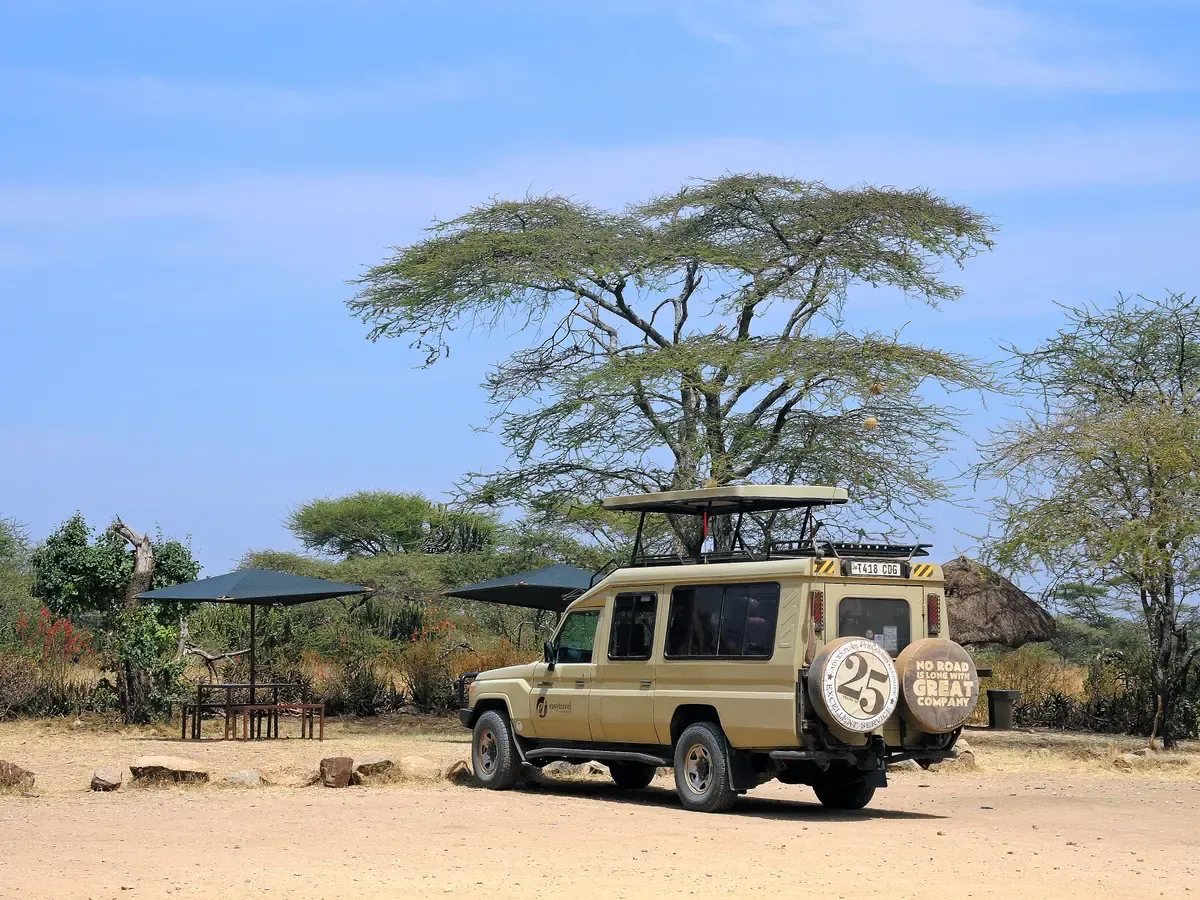
A pop-up-roof safari Land Cruiser parked in the shade of an acacia. Photo: Güldem Üstün, CC BY 2.0, via Wikimedia Commons
Villages, Zanzibar and Ramadan
The safari circuit ends or begins in places where the game-drive wardrobe is not appropriate. Modest dress is the rule in villages and on Zanzibar.
Maasai Villages and Tanzanian Towns
Tanzania is largely conservative, and Aza Fashions advises covering shoulders and knees in Stone Town and carrying a scarf for mosques and markets. Born Wild advises women in Zanzibar towns and villages to wear long shirts and full-length trousers or light long dresses, plus a sarong for religious sites. Talk of the House's advice to avoid form-fitting or revealing clothing applies anywhere off the vehicle.
Practically, the long trousers and sleeved shirts you wear for game drives already meet the standard, so a village stop needs no extra outfit, only a scarf if your shoulders are exposed. A package such as the 5-Day Serengeti Camping Safari at $1,320 per person lists Mto wa Mbu village among its stops, so keep one modest layer reachable on transit days.
Zanzibar and Stone Town
Go2Africa describes Zanzibar as a conservative, predominantly Muslim society and advises covering shoulders and knees in Stone Town and local villages, while confirming swimwear and shorts are fine at a resort or on the beach. Tanzania Specialist is specific about women: avoid short skirts, thigh-high shorts, sleeveless shirts and revealing tops in Stone Town, but capri trousers, knee-length shorts and long dresses are fine. Born Wild says bikinis are fine on Zanzibar beaches and in resort areas, so the rule is location-based, cover up the moment you walk into town. Aza Fashions advises putting a cover-up on before walking into Stone Town or coastal villages.
If you combine the coast with the bush, the Zanzibar to Serengeti Safari at $1,875 per person flies from Zanzibar to Seronera and back with one lodge night at Africa Safari Serengeti Ikoma, so pack a cover-up for the Zanzibar side and neutrals for the drive. The Serengeti Fly-In Safari at $2,750.77 per person can also start in Zanzibar, Arusha or Dar es Salaam. Travel Counsellors recommends a 40 to 50 litre soft-sided duffel.
Ramadan on the Island
Ramadan changes the dress and dining picture on Zanzibar each year, and the dates shift annually. The Zanzibar Commission for Tourism issued Ramadan guidelines asking visitors to dress modestly in public areas, a request that applies to visitors and residents alike, and it asked that beachwear and revealing clothing be confined to beaches and hotel compounds. The East African reports that during Ramadan restaurants outside hotels in Zanzibar must close in the daytime, and the commission called the measures educational rather than punitive.
Go2Africa often advises travellers to avoid Zanzibar during Ramadan because many businesses and services shut down. The practical packing consequence is small but real: a light long dress or a scarf-and-cover-up combo earns its space if your trip overlaps the fasting month, and beachwear stays at the hotel.
Do and Don't
Five rules to follow and four to break, each with the reason a source gives.
Do
- Do wear neutral, medium-weight fabrics in khaki, olive, beige or tan, because the CDC says tsetse flies bite through thin material and are drawn to bright and very dark colours.
- Do pack a fleece and a windproof shell even in the dry season, because Expert Africa says warm clothing matters most on the Ngorongoro Crater and the Serengeti from June to the end of August, and rim nights often drop below 10°C (50°F).
- Do bring a wide-brimmed hat with a drawstring or chin strap, because Duma Explorer and Talk of the House both note it stays on in an open game-drive vehicle while shading face and neck.
- Do pack enough underwear for the whole trip and a travel-size detergent, because Travelpander and Kagera Safaris say some camps do not wash underwear for cultural reasons and provide detergent instead.
- Do use a repellent with 20 percent or more DEET and treat clothing with permethrin, because the CDC recommends exactly this against mosquitoes in Tanzania, where malaria risk exists below 1,800 m (5,906 ft).
Don't
- Don't pack any camouflage clothing, bags or even camo-print backpack straps, because Duma Explorer and Born Wild say camouflage is illegal in Tanzania for anyone who is not military and offenders may be fined and lose the items.
- Don't wear blue or black on game drives in wooded areas, because Expert Africa and Foot Slopes Tours report that black attracts tsetse flies and Expert Africa adds blue, and Classic Africa Safaris calls their bites quite painful.
- Don't wear a jumpsuit or romper on a game drive, because Maps and Merlot and Have Clothes Will Travel warn they are hard to remove quickly at bush bathroom stops.
- Don't rely on jeans as a staple, because Tanzania Specialist says they are heavy and slow to dry, which defeats a 3 to 5 outfit wardrobe built around daily laundry.
Questions About Safari Clothes for Women
What do people wear on a safari in Tanzania?
Neutral-coloured long trousers, shirts with sleeves, a warm mid layer and a windproof shell, in khaki, olive or beige. Tanzania Specialist recommends exactly these three layers because mornings can dip below 10°C (50°F) while midday reaches about 30°C (86°F). The CDC adds long sleeves and long pants in medium-weight fabric against tsetse bites. For the full kit beyond clothing, see the safari packing list.
What are some good clothes for women on a safari?
Zip-off or convertible trousers, a UPF long-sleeve shirt over a tank, a supportive sports bra for bumpy roads, and one dress for dinner. Maps and Merlot advises all of these, and Foot Slopes Tours tells women to plan roughly 3 to 5 mix-and-match outfits because most lodges offer laundry. The item-by-item grid is in The Core Safari Outfit for Women.
How many outfits should a woman pack for a 5-day safari?
Roughly 3 to 5. Foot Slopes Tours says plan on 3 to 5 outfits that can be mixed and layered because most lodges offer laundry, and Tanzania Specialist says 3 to 4 outfits can cover even a two-week trip with same-day or next-day washing. Pack enough underwear for every day, since Travelpander says some camps do not wash it. Compare trip lengths on the Serengeti safari packages homepage.
What should women not wear on safari?
No camouflage, which Duma Explorer says is illegal in Tanzania for civilians, no blue or black, which Expert Africa says attract tsetse flies, and no white, which Foot Slopes Tours says gets dirty quickly. The CDC also warns against bright and very dark colours for the same tsetse reason. The shade-by-shade detail lives in the what to wear on safari guide.
What shoes should a woman wear on a Tanzania safari?
One pair of sturdy, broken-in, closed-toe shoes for drives and walks, plus one pair of sandals for lodge and pool time. Duma Explorer advises sturdy closed-toe shoes and sandals, Tanzania Specialist suggests exactly one walking pair and one sandal pair, and Ultimate Kilimanjaro prefers closed-toe shoes over flip-flops because of poor traction. Kandoo Adventures warns against brand-new shoes that cause blisters.
What should women wear in Zanzibar after a safari?
Cover shoulders and knees in Stone Town and local villages, where Go2Africa describes a conservative, predominantly Muslim society, while bikinis and shorts are fine at a resort or on the beach. Tanzania Specialist says capri trousers, knee-length shorts and long dresses are all fine in town. During Ramadan, the Zanzibar Commission for Tourism asks visitors to dress modestly in public and keep beachwear to beaches and hotel compounds.