 Serengeti Safari Packages
Safari Packing List: What to Pack for a Tanzania Safari
This safari packing list covers what to bring on a Tanzania safari and what to leave at home. The bag matters first, because light aircraft to the Serengeti enforce strict weight limits and want soft bags. Then come clothes in short, binoculars and camera gear, power adapters, a headlamp, sun and insect protection, medicines, documents, cash for tips, and the items to leave at home, such as plastic bags, drones and camouflage. Every figure here comes from an airline, the CDC or a named publisher. The bookable trips are compared on Serengeti safari packages compared.
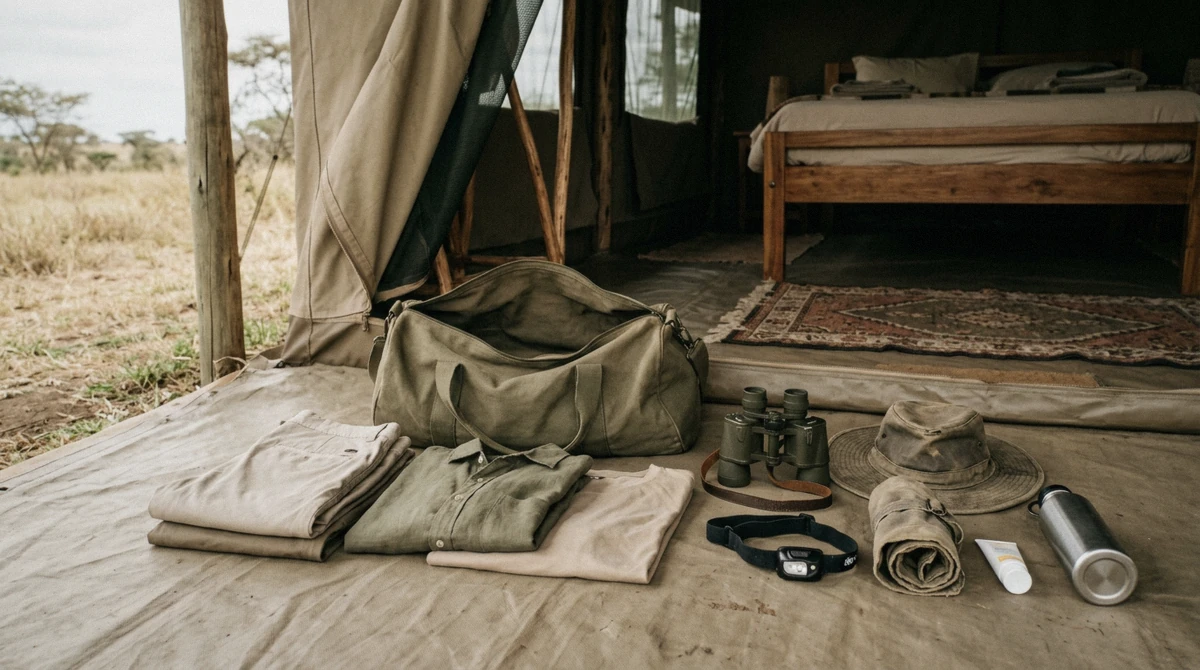
A packing layout for a tented-camp safari.
Quick answer The short version
Pack a soft-sided duffel weighing 15 kg (33 lb) or less including your daypack, because Duma Explorer says East African light aircraft enforce about 15 kg combined for the main duffel and daypack. Add earth-tone clothes in three layers, 8x42 or 10x42 binoculars, a type G power adapter, a headlamp, repellent with 20 percent or more DEET, your passport, malaria medicine and US cash in good condition. Leave plastic bags, drones and camouflage at home.
Key takeaways
- Bag first: Coastal Aviation allows 15 kg per passenger and Auric Air allows 20 kg including hand baggage, so check which airline your trip uses before you pack. Fly-in trips such as the Serengeti Fly-In Safari depend on these limits.
- Clothes in layers: mornings on open vehicles and the Ngorongoro rim can drop below 10°C (50°F) while midday reaches about 30°C (86°F). Detail lives in the guide to what to wear on safari.
- Compare trip styles before you pack, because a road safari needs less discipline than a fly-in. See the comparison of Serengeti safari packages or the range of Serengeti safari tours on the homepage.
The Bag and the Weight Limit
Your single most important packing decision is the bag itself, because baggage rules on Tanzanian light aircraft are strict and enforced on the tarmac.
Soft Bags Only on Fly-in Trips
Bush planes such as the Cessna Caravan have small, oddly shaped holds, and Duma Explorer notes that rigid suitcases simply do not fit them. Coastal Aviation says soft bags are strongly recommended and lists a soft duffle of 40 x 40 x 80 cm (16 x 16 x 31 in) as fitting comfortably in the hold. A hard-shell bag must fit its cargo pod door of 76 x 48 x 29 cm (30 x 19 x 11 in). Duma Explorer advises a soft duffel of roughly 50 to 80 litres and weighing the packed bag at home.
The limits differ by airline, and that is the conflict to know. Coastal Aviation allows 15 kg (33 lb) per passenger including carry-on, while Auric Air allows a total of 20 kg (44 lbs) including hand baggage and cameras, and Duma Explorer records Air Excel at 20 kg. Duma Explorer sums up East Africa: light aircraft in Tanzania, Kenya, Uganda and Rwanda enforce about 15 kg combined for main duffel and daypack. Auric Air sells excess baggage in 10 kg slabs at $60 per slab on Safari and Bush routes, and Coastal Aviation carries excess only at its discretion at the prevailing freight rate, with the pilot holding the final say on load. Coastal also sells a premium XL seat with a 30 kg (66 lb) allowance, subject to availability.
If you fly in, pack to 15 kg and you satisfy every airline on the list. Both the Serengeti Fly-In Safari, a 3-day private trip at $2,750.77 per person, and the Zanzibar to Serengeti Safari, 2 days at $1,875 per person, use scheduled flights, so a soft duffel is the right call for both. Coastal lets passengers store unneeded items at its Terminal 1 office at Dar es Salaam airport, useful if you continue to the beach.
| Airline or trip | Limit | Bag rule |
|---|---|---|
| Coastal Aviation | 15 kg (33 lb) per passenger including carry-on | Soft bags strongly recommended. Duffle of 40 x 40 x 80 cm fits the hold. Hard bags must fit a 76 x 48 x 29 cm pod door |
| Auric Air | 20 kg (44 lbs) total including hand baggage and cameras | Soft-sided bags recommended for the aircraft pods. One piece max 90 x 65 x 35 cm |
| Air Excel | 20 kg per person | Recorded by Duma Explorer |
| East Africa general | About 15 kg combined duffel plus daypack | Per Duma Explorer. Southern Africa allows 20 kg |
| Excess baggage | Auric Air: $60 per 10 kg slab on bush routes | Coastal: carried at its discretion at the prevailing freight rate |
Road Safaris Are Easier on Luggage
If your trip starts and ends in Arusha by road, no bush-plane limit applies to your main bag. The camping and lodge safaris that drive to the parks, such as the 3-Day Serengeti Big Five Safari at $900 per person or the 4-Day Serengeti Mid-Range Safari at $1,750 per person, carry your luggage in the vehicle the whole way. Even so, a soft bag helps, because vehicles pack tighter than a hotel room and some lodges prefer manageable bags.
Have Clothes Will Travel notes that lodges often limit luggage to about 15 kg (33 lbs). A daypack stays with you in the vehicle for cameras, repellent and layers.
Sources: Coastal Aviation, Auric Air, Duma Explorer
The Checklist
Gear matters more than quantity on a Serengeti circuit trip. The table below covers the items that earn their space in a 15 kg bag.
Gear, Power and Health Items
Binoculars top most lists for a reason. Duma Explorer recommends 8x42 or 10x42 models because larger objective lenses gather more light for early and late viewing, and SafariFind suggests about one pair per one to two travellers, kept near the seat rather than in a bag. Expert Africa calls binoculars essential and lists a torch and a camera with charger, spare batteries and memory cards alongside them. A headlamp serves as that torch and keeps your hands free around camp after dark.
Power needs planning. Tanzania uses type G three-pin plugs at 230 V and 50 Hz, so bring a suitable adapter. Duma Explorer explains that dual-voltage devices marked 100-240V need only the adapter, while single-voltage devices such as some hair dryers need a converter, and advises a power bank of at least 10,000 mAh because camp electricity may be limited. For health, carry prescription medicines plus a copy of the prescription, and build a small first-aid kit. Duma Explorer suggests pain relievers, antihistamines, loperamide and rehydration salts. Malaria medicine is a discussion with a travel clinic, covered in the documents section below. Sun and insect protection belongs on every list: Expert Africa lists sunglasses, sunscreen, lip balm, a shady hat and insect repellent as essentials. The CDC recommends a repellent with 20 percent or more DEET, with picaridin and oil of lemon eucalyptus as alternatives, and advises treating clothing with permethrin, never applying permethrin to skin. Duma Explorer advises DEET at 25 to 30 percent in cream or roll-on form rather than aerosol, used mainly at dawn and dusk.
| Item | Why | Note |
|---|---|---|
| Binoculars 8x42 or 10x42 | More light gathered for early and late game viewing | About one pair per one to two travellers, kept near the seat |
| Camera, charger, spare batteries, memory cards | Listed as essential by Expert Africa | Long lenses are heavy, weigh your bag after packing |
| Headlamp or torch | Camp paths and tents are dark at night | Keeps hands free. Expert Africa lists a torch as essential |
| Type G power adapter | Tanzania runs 230 V, 50 Hz with type G sockets | Dual-voltage gear needs only an adapter, single-voltage needs a converter |
| Power bank 10,000 mAh or more | Camp electricity may be limited | Per Duma Explorer |
| Sunscreen, lip balm, shady hat, sunglasses | Midday on an open vehicle is hot and exposed | Listed as essentials by Expert Africa |
| Insect repellent | Malaria risk below 1,800 m per the CDC | CDC: 20 percent or more DEET. Duma Explorer: 25 to 30 percent, cream or roll-on, at dawn and dusk |
| Medicines and first-aid kit | Remote camps are far from pharmacies | Prescription plus copy, pain relievers, antihistamines, loperamide, rehydration salts |
Clothes in Short
The full detail lives in the guides, so here is the short version. Tanzania Specialist says morning game drives can dip below 10°C (50°F) while midday reaches about 30°C (86°F), and recommends three layers: a moisture-wicking long-sleeve base, a mid-weight fleece or softshell, and a windproof water-resistant shell. Discover Africa says Ngorongoro temperatures seldom rise above 25°C by day and often drop below 10°C at night, and that the altitude gap between crater floor and rim builds significant mist in the early mornings, so the cold on the rim is real. Earth tones win: khaki, olive, beige and muted brown blend in, stay cooler and hide dust. Skip white, which shows dust, and black and dark blue, which several publishers say attract tsetse flies. Camouflage is out, as the publishers cited below say.
Laundry changes the math. Tanzania Specialist says most lodges and camps offer same-day or next-day laundry, often included, and that three to four outfits can cover a two-week trip. One exception: some camps will not wash underwear for cultural reasons, so Travelpander advises packing enough for the whole trip. For women, see the page on safari clothes for women. For men, see safari clothes for men.
Sources: Duma Explorer, CDC, WorldStandards
What to Pack for a Tanzania Safari: Altezza Travel
What to pack for a Tanzania safari, from clothes to gear. Third-party video by Altezza Travel. This site did not shoot it and has no relationship with the creator.
Documents, Money and Health
Paperwork and cash are part of the packing list. Get these right before you leave home, because fixing them at a border or a bush airstrip is hard.
Passport, Visa and Yellow Fever
SafariFind says your passport must be valid at least 6 months beyond your intended departure date with at least one blank page, and the UK government says it must expire at least 6 months after arrival, also with one blank page. A tourist visa is required. SafariFind lists a single-entry visa at $50 USD valid up to 90 days and a multiple-entry visa at $100 USD, while Duma Explorer says US passport holders pay $100 for a mandatory Multiple Entry Visa with no cheaper single-entry option. Apply online at visa.immigration.go.tz, where Duma Explorer reports official processing of 3 to 10 business days with most decisions in 4 to 6. Duma Explorer says visas on arrival are issued at Kilimanjaro, Dar es Salaam and Zanzibar airports and major land borders such as Namanga, and that the wait usually runs 15 to 60 minutes with longer queues in June to October and December. Duma Explorer also says a return or onward ticket must be shown at entry. The visa has its own page, so see the guide to the Tanzania visa for the full picture.
The yellow fever certificate follows your route, not your passport. The CDC says the vaccine is generally not recommended for travel to Tanzania, but travellers arriving from countries with transmission risk must be vaccinated. Arrivals from Kenya, Uganda, Zambia and Rwanda need proof, and SafariFind says the certificate applies after a transit of 12 hours or more through an endemic country. Bring the original WHO yellow booklet, because photocopies are not accepted. Duma Explorer advises carrying it anyway since some officers may ask.
Insurance and Evacuation
Duma Explorer advises travel insurance that covers medical evacuation, and warns that standard policies often exclude walking safaris and bush evacuation unless specifically listed. The cost it cites is blunt: emergency air evacuation from a remote camp runs $10,000 to $50,000. AMREF Flying Doctors sells a Maisha Tourist plan whose Silver, Gold and Platinum covers run 30 days, and Tanzania and Zanzibar are covered under those tiers but not Bronze.
Note the gap Duma Explorer flags: AMREF covers transport to a hospital only and does not pay hospital bills, so a full travel policy is still needed on top.
Cash and Tipping Money
Expert Africa says US dollars are the most useful currency in Tanzania, with MasterCard and Visa the most widely accepted cards. Condition matters: Duma Explorer advises US bills printed after 2006 in good condition, saying older or damaged notes are often refused, and SafariFind says bills should be Series 2009 or newer with no tears. SafariFind says up to $10,000 USD can be brought in or out without declaration, and that non-residents may not import or export Tanzanian shillings.
Plan the tips in small bills. Duma Explorer budgets $10 to $20 per person per day for the driver-guide and another $10 to $20 for other staff, and estimates $200 to $350 per person in tips for a 7-day safari. Tanzania Specialist suggests 10 USD per day per person in your group for the driver-guide and a shared staff tip box of 5 to 10 USD per night at lodges, while Duma Explorer separately suggests $50 per vehicle per day shared among passengers for the guide and $10 to $15 per guest per day for lodge staff. ATMs typically cap withdrawals at 400,000 to 600,000 shillings, about $140 to $220, per Duma Explorer, so bring what you need rather than counting on machines.
Malaria is the last health item to pack for. The CDC says malaria risk applies in all areas below 1,800 m (5,906 ft) and that chloroquine is not recommended because of resistance, with the disease mainly Plasmodium falciparum. The CDC lists atovaquone-proguanil, doxycycline, mefloquine and tafenoquine as preventive medicines for Tanzania, and Duma Explorer names Malarone, doxycycline and mefloquine as the common options and advises seeing a travel clinic four to six weeks before departure. The CDC also recommends hepatitis A and typhoid vaccines for most travellers, and says anyone with fever within a year of returning from a malaria area needs urgent evaluation.
Sources: CDC, SafariFind, Duma Explorer, AMREF Flying Doctors
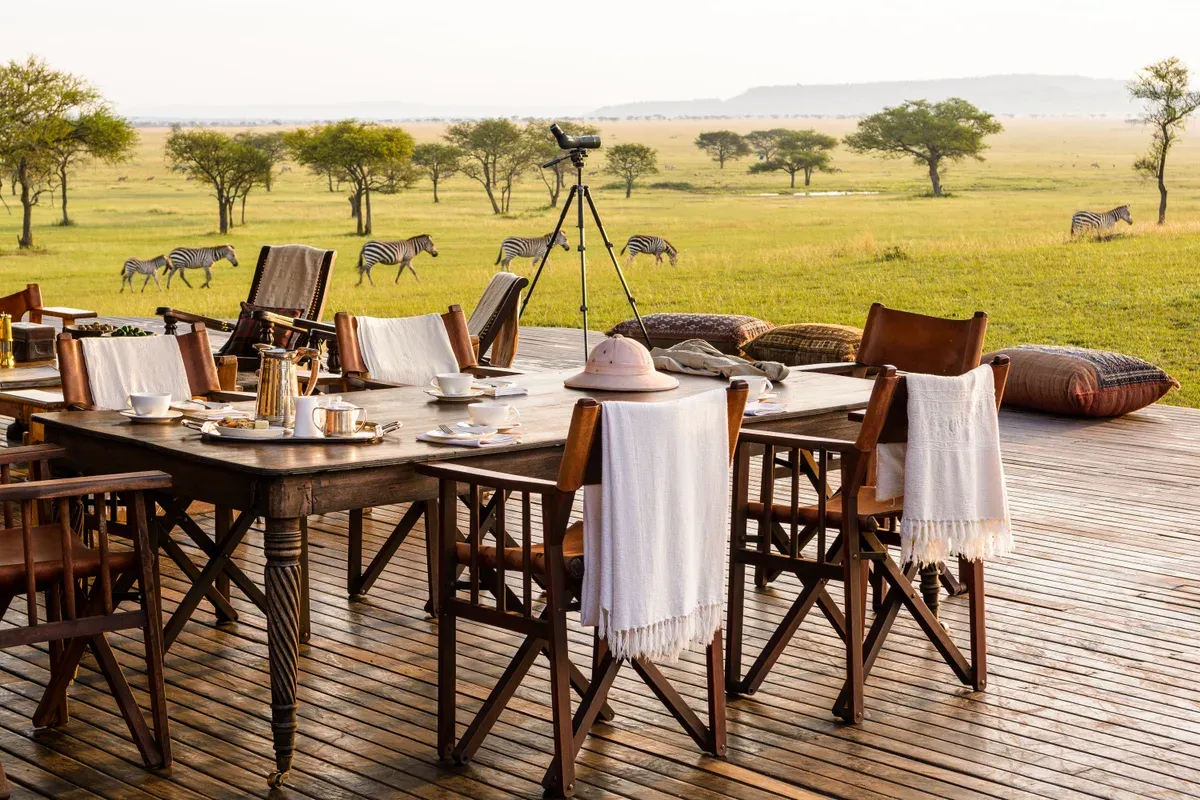
The deck at Singita Sabora Tented Camp in the Serengeti, with zebra in the distance. Photo: Jessica138, CC BY-SA 4.0, via Wikimedia Commons
What Not to Pack
Three items will cause trouble at entry or in the parks. All three are easier to leave at home.
Plastic Bags
Tanzania has banned single-use plastic bags since 1 June 2019, and Duma Explorer says the ban covers all plastic bags regardless of thickness, and a travel advisory from Climb Mount Kilimanjaro says it applies to tourists arriving at any airport. Zip-lock bags for hygiene kits or documents are exempt provided they are not discarded in the country, and a later update officially allowed ziploc bags into the country, so zip-lock pouches for documents are fine. Swap shopping and garbage bags for packing cubes and cloth pouches, as Duma Explorer recommends.
Drones
Leave the drone unless you hold written permission well in advance. The Tanzania Civil Aviation Authority says all drone operations, including recreational, require TCAA approval and a permit, and that the permit takes 3 to 4 weeks for non-residents, who should apply at least 3 to 4 weeks before arrival. The TCAA FAQ says drones may fly in national parks with an additional permit from the park authority, but TANAPA banned drones in national parks including Serengeti from 6 November 2014, and Easy Travel Tanzania says drones are prohibited in all national parks and on-the-spot permissions are not granted.
Treat the parks as closed unless you hold that written permission. Easy Travel warns that flying without authorisation can lead to confiscation, fines up to one million Tanzanian shillings and possible detention.
Camouflage
Camouflage-patterned clothing is illegal in Tanzania except for military personnel on official business, per Duma Explorer. The ban covers jackets, pants, hats, bags and even backpack straps with camo accents, including hunting camo. Tanzania Specialist, Foot Slopes Tours, SafariFind and Ultimate Kilimanjaro all repeat the prohibition, and Born Wild says offenders may be fined and lose the clothing.
Note that no official government legal text has been published on this, so these are publisher claims, but the advice is unanimous: leave camo at home. Modest dress also matters beyond the parks. Zanzibar is a conservative, predominantly Muslim society, and Go2Africa advises covering shoulders and knees in Stone Town and local villages, with swimwear fine at a resort or on the beach.
Sources: Duma Explorer, TCAA, Easy Travel Tanzania
Packing Dos and Don'ts
Do
- Do pack a soft duffel of 15 kg or less combined, because East African light aircraft enforce that combined limit and the pilot has the final say on load.
- Do bring three clothing layers, because mornings on open vehicles and the Ngorongoro rim can fall below 10°C (50°F) while midday reaches about 30°C (86°F).
- Do carry US cash printed after 2006 in good condition, because older or damaged notes are often refused and tips for a 7-day safari are estimated at $200 to $350 per person.
- Do see a travel clinic four to six weeks before departure, because the CDC lists four malaria preventive medicines for Tanzania and chloroquine is not recommended there.
- Do bring the original WHO yellow fever booklet if you arrive from or transit 12 hours or more through a risk country such as Kenya, because photocopies are not accepted.
Don't
- Don't pack plastic shopping or garbage bags, because Tanzania's ban has covered all single-use plastic bags since 1 June 2019, including at airports.
- Don't bring a drone without a TCAA permit applied for at least 3 to 4 weeks ahead, because TANAPA has banned them in national parks since 6 November 2014 and fines can reach one million shillings.
- Don't wear black, dark blue or camouflage, because publishers report dark colours attract tsetse flies and camo is illegal for civilians in Tanzania.
- Don't rely on Tanzanian ATMs for tip money, because withdrawals typically cap at 400,000 to 600,000 shillings, about $140 to $220.
Safari Packing List FAQ
How heavy can my bag be on a Serengeti fly-in safari?
Coastal Aviation allows 15 kg (33 lb) per passenger including carry-on, while Auric Air allows 20 kg (44 lbs) total including hand baggage and cameras. Pack to 15 kg and you are safe on either, ideally in the soft duffle described above.
Do I really need a soft bag for a Tanzania safari?
For any trip using light aircraft, yes. Coastal Aviation lists a soft duffle of 40 x 40 x 80 cm as fitting the hold, and hard bags must squeeze through a 76 x 48 x 29 cm pod door. Road-based trips such as the 3-Day Serengeti Big Five Safari have no bush-plane limit.
What colors should I pack for safari?
Earth tones such as khaki, olive, beige and muted brown, because Tanzania Specialist says they blend in, stay cooler and hide dust. Avoid white, which shows dust, and black and dark blue, which attract tsetse flies. The page on what to wear on safari has the full list.
How much cash should I bring for tips?
Duma Explorer budgets $10 to $20 per person per day for the driver-guide and another $10 to $20 for other staff, or about $200 to $350 per person for a 7-day safari, in US bills printed after 2006 in good condition. Tanzania Specialist suggests 10 USD per day per person in your group for the guide.
Do I need malaria pills for the Serengeti?
The CDC places malaria risk in all areas of Tanzania below 1,800 m (5,906 ft), and lists atovaquone-proguanil, doxycycline, mefloquine and tafenoquine as preventive options. See a travel clinic four to six weeks before departure, and pack a repellent with 20 percent or more DEET.
Can I bring a drone or plastic bags into Tanzania?
Plastic shopping and garbage bags are banned, though ziplocks you carry out are exempt. Drones need TCAA approval applied for 3 to 4 weeks ahead, and TANAPA has banned them in national parks since 6 November 2014, so treat parks such as the Serengeti as closed. Planning a trip around the herds instead? See the Great Migration Serengeti guide.