 Serengeti Safari Packages
The Great Migration Serengeti: Where the Herds Are and How to Plan
The Great Migration Serengeti question is really a rain question. More than a million wildebeest, plus zebra and gazelle, walk a wide loop through Tanzania and Kenya each year, calving on the southern plains, crossing the Grumeti and Mara rivers, and turning south again. This page explains the numbers, the month by month pattern, the crossings and how to pick a safari package around them, with the honest limits of every prediction. If you want weather and prices by month, see the best time to visit Serengeti guide. The bookable trips are compared on Serengeti safari tours.
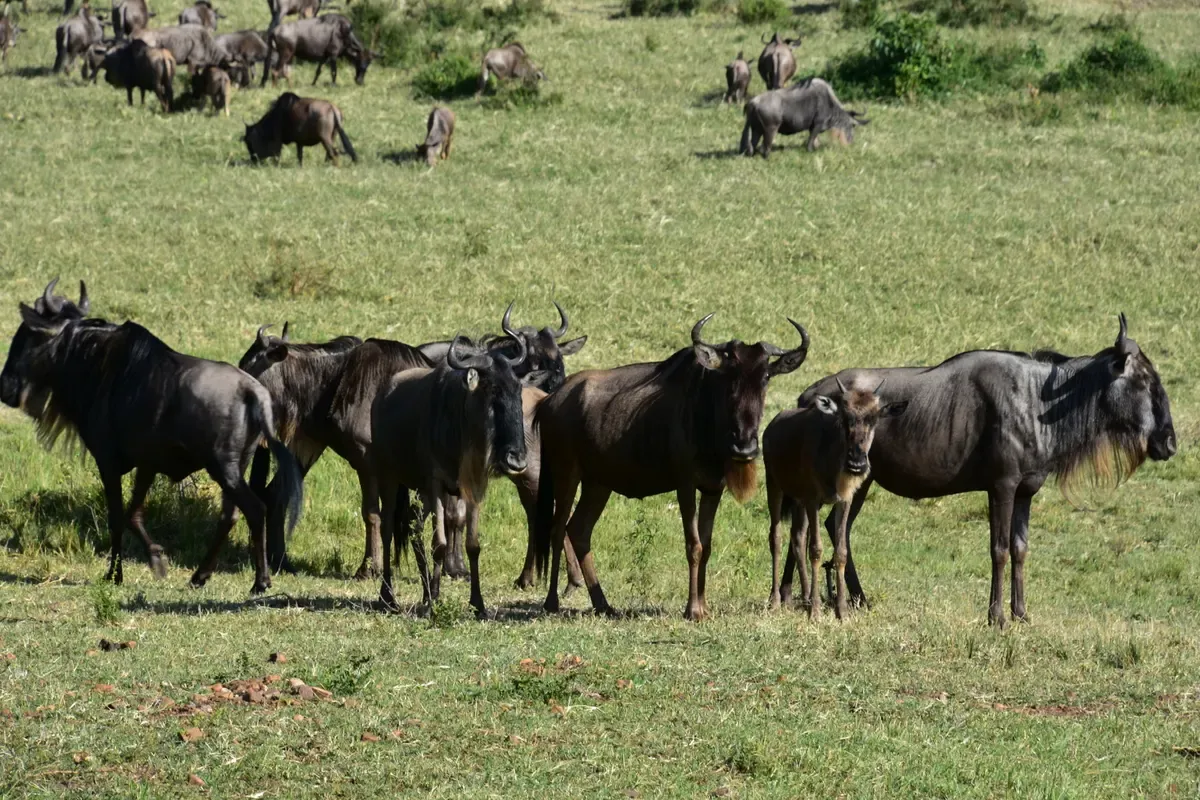
Blue wildebeest on the Serengeti plains. Photo: Richard Mortel from Riyadh, Saudi Arabia, CC BY 2.0, via Wikimedia Commons
Quick answer The migration in brief
The Great Migration Serengeti is a loop of more than 1.5 million wildebeest, roughly 250,000 zebra and hundreds of thousands of gazelle, moving with the rain. In a usual year they calve near Ndutu in the south, reach the Grumeti River around June and the Mara River from July, then head south again from late October, though the timing moves with the rain.
Key takeaways
- The full month by month pattern, with calving and the crossing months, is in the calendar section.
- For the Mara River itself, the 8-Day Serengeti Migration Safari carries 2 northern nights for $4,257 per person.
- Calving happens around Ndutu, and the Ndutu guide covers that area in detail.
- See how all trip types line up in the comparison table.
How Many Animals and Why They Move
The headline figure is more than a million wildebeest, but published counts differ, and the animals move because of rain and grass rather than a fixed timetable.
The Numbers, With Their Conflicts
Every major source agrees the wildebeest count is at least about 1.3 million, but the exact figures disagree, and so do the zebra and gazelle counts. SafariBookings describes more than 2 million animals in total on the loop. The table below shows the counts each source gives so you can judge for yourself. None of these are official census counts of a single year, and the herd is a moving population that is hard to count.
The death toll is part of the picture. Wikipedia's Serengeti National Park article records about 250,000 wildebeest and 30,000 zebras dying each year from drowning, predation, exhaustion, thirst or disease. For every wildebeest taken by a crocodile at the Grumeti and Mara rivers, 50 drown. A calf weighs about 19 kg at birth, stands within minutes, and 80 to 90 percent of calves are born within a three-week window.
| Animal | Number | Source |
|---|---|---|
| Wildebeest | More than 1.5 million | Wikipedia, Serengeti National Park |
| Wildebeest | 1.7 million | Wikipedia, Serengeti |
| Wildebeest | About 1.3 million | Wikipedia, Maasai Mara |
| Zebra | About 250,000 | Wikipedia, Serengeti National Park |
| Zebra | 260,000 | Wikipedia, Serengeti |
| Thomson's gazelle | 400,000 to 500,000 | Wikipedia, Serengeti National Park |
| Gazelle | About 300,000 | Duma Explorer |
| Grant's zebra | 200,000 | Wikipedia, Maasai Mara |
The Loop, the Rain and the Grass
The herds walk a wide circuit through the Serengeti-Maasai Mara ecosystem. SafariBookings puts the loop at about 800 km (500 mi). Eos, a science news outlet, describes roughly 1.2 million animals travelling about 500 km a year clockwise. The two figures differ by source, but both make it one of the longest overland migrations left on Earth. Wikipedia says only three long-distance wildebeest migrations remain, in the Serengeti, Tarangire and Kafue.
The engine is rainfall and fresh grass. Duma Explorer says the movement is driven almost entirely by rain and the availability of new growth, and African Overland Tours calls every published timing an expert estimate, not a guarantee, because the migration moves with the rain. Geoscientist Simon Kübler of Ludwig Maximilian University of Munich has suggested, in preliminary results reported by Eos, that soil chemistry also plays a role. Ash from Ol Doinyo Lengai, about 50 km east of the park, is rich in sodium and calcium and enriches the southeastern soils. The practical point for trip planning stands regardless of the mechanism. Exact timing changes each year, the general pattern does not, and no operator can promise where the herds will stand on your travel dates.
Sources: Wikipedia, SafariBookings, Eos, Duma Explorer
Month by Month
The pattern below is the usual one drawn from Wikipedia, Duma Explorer, African Overland Tours and Africa Geographic. It moves with the rain, so treat every month as an estimate.
The Usual Pattern
Sources disagree on the edges of several windows, and where they do, both dates are shown. Wikipedia even gives April to May for the western corridor in one section and May to July in another. Use the table to pick a region, not a promise.
If your dates fall between two rows, ask operators where their camps moved in recent seasons.
| Months | Where the herds usually are | What happens |
|---|---|---|
| January to March | Southern Serengeti and the Ndutu plains | Calving. About 500,000 calves born in roughly 2 to 3 weeks in February, up to 8,000 per day at peak |
| April | Moving north through the Seronera Valley toward the Western Corridor | Long rains start and the herds begin the trek north |
| May | Central and western Serengeti | Heavy rain. Africa Geographic has the herds heading for the Grumeti River |
| June to July | Western Corridor at the Grumeti River | First Grumeti crossings. African Overland Tours puts the first one in June, Duma Explorer gives June to July |
| July | Northern Serengeti, reaching the Mara River | First Mara crossings from mid to late July depending on conditions |
| August | Mara River, northern Serengeti and southern Kenya | Peak of Mara River crossings, tens of thousands of wildebeest and zebra |
| September to October | Mara-Serengeti border zone, then drifting south through the Lobo area | Crossings in both directions, then the return trek as the dry season ends |
| November to December | Back through central Serengeti to the southern plains | Short rains pull the herds south. Early calving sometimes starts in late December |
Calving at Ndutu
The calving grounds sit on the short-grass plains around Lake Ndutu and the southern Serengeti. Wikipedia describes the Ndutu area as a calving ground for wildebeest and zebras from roughly January to March, and African Overland Tours and Africa Geographic both give peak calving in February, with about 500,000 calves born within two to three weeks. Duma Explorer states up to 8,000 calves can drop per day at the peak. Wild Wings Safaris widens the window, saying the herds settle on the Ndutu plains from about November to March or April and that calving runs from December through May, so the sources differ on how long the season lasts.
Ndutu sits in the northern part of the Ngorongoro Conservation Area, about 280 km and roughly six hours by road from Arusha, and the flight to the Ndutu airstrip takes just under an hour. Predator action is at its highest of the year here, with hyenas, cheetahs, leopards and lions working the herds. The Ndutu guide covers lodging, rules and fees for the area. For the full weather picture month by month, read the best time to visit Serengeti guide.
Sources: Wikipedia, Africa Geographic, Wild Wings Safaris
The Serengeti Wildebeest Migration Explained: Expert Africa
The wildebeest migration circuit through the Serengeti and Masai Mara explained by month. Third-party video by Expert Africa. This site did not shoot it and has no relationship with the creator.
The River Crossings
The crossings are the most famous, and the least predictable, days of the migration.
Grumeti First, Then the Mara
The first big river is the Grumeti in the Western Corridor. African Overland Tours places the first Grumeti crossing in June, Duma Explorer gives June to July, and Wikipedia's Grumeti River article stretches it from May through August. The herds usually stay near the Grumeti until late June before pushing north. The marquee event is the Mara River crossing in the north, where the herds funnel to the water from July. Duma Explorer gives July to September in its body text and July to October in its FAQ, African Overland Tours says crossings run into October and end as the herds move into Kenya, and Wikipedia says the animals typically cross around July depending on weather and head back south around October. Both windows are estimates because it moves with the rain.
The Mara River itself is 395 km long, rises on the Mau Escarpment at about 3,000 m and ends in Lake Victoria in Tanzania. About 65 percent of its basin lies in Kenya and 35 percent in Tanzania, and it can swell to twice its normal size after heavy rain.
Crocodiles, Crowds and Uncertainty
Wikipedia says about 3,000 Nile crocodiles wait at the Grumeti and Mara crossings, and SafariBookings confirms hippos and crocodiles live in both rivers. A single crossing can carry about 3,000 wildebeest, per a photo caption Wikipedia records, and during the trek north the columns of animals can stretch up to 40 kilometers long. The danger is not only teeth. Wikipedia notes that for every wildebeest taken by a crocodile, 50 drown in the crush.
The honest warning comes from Duma Explorer. No safari operator can guarantee a river crossing, and animals may wait days at the bank before entering the water. That is why packages that give you several nights in the northern Serengeti, rather than one, improve your odds without removing the risk. On the Kenya side of the line, the Maasai Mara hosts the same herds from late July or August until early November, and its Mara Triangle section is managed by the Mara Conservancy. Your Serengeti package does not cross into Kenya, so a Mara-side visit would be a separate trip on a separate permit.
Sources: Duma Explorer, Wikipedia, Mara River, African Overland Tours
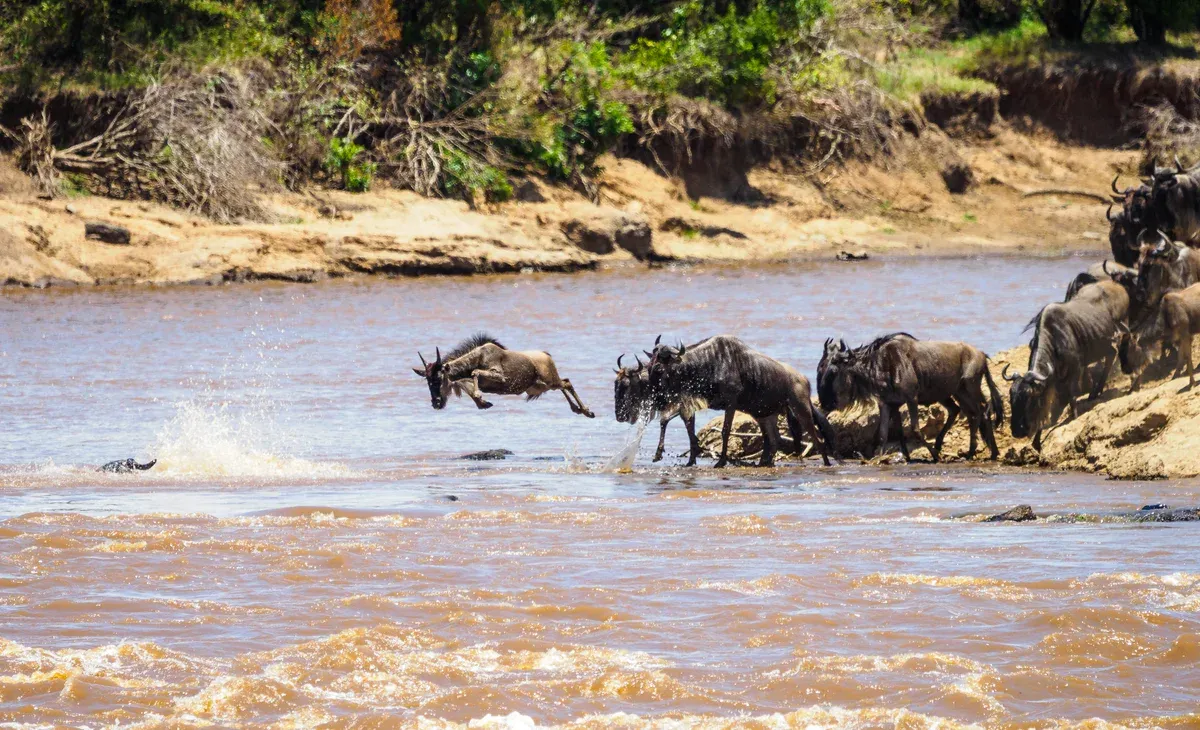
Wildebeest crossing the Mara River. Photo: Danijel Mihajlovic, CC BY-SA 4.0, via Wikimedia Commons
Planning a Trip Around the Herds
Match your dates to a region first, then pick a package that sleeps in that region for more than one night.
Match the Month to the Region
For calving in February, look for itineraries that reach Ndutu and the southern plains. For the Grumeti season in June and July, the Western Corridor is the target. For the Mara River from July to October, you need the far north around Kogatende.
SafariBookings sums up the classic picks as January to February for calving at Ndutu, June to July for the Western Corridor and August to September for Mara River crossings. Roadtrip Africa agrees on January to March at Ndutu and names August the peak for crossings into the Masai Mara. Balloon flights track the herds too.
Serengeti Balloon Safaris launches from the Central Serengeti year-round, the Western Corridor and North Serengeti from June to October, and Ndutu from 20 December to 31 March. For how seasons and prices shift, see the best time to visit Serengeti guide.
The Migration Packages, Honestly Priced
Three catalog trips are built around the migration. The pick for most travelers is the 8-Day Serengeti Migration Safari at $4,257 per person. It is a private 8-day, mid-range trip from Arusha for 2 to 6 adults, with park fees and all taxes and VAT included, and 7 nights in lodges and camps including 2 nights at Heritage Mara Camp in the northern Serengeti. It excludes international flights, and its age band is 18 to 64.
The Mara River Crossing Safari costs $3,763 per person for 6 private days from Arusha, with 3 nights in mobile tented camps that move with the migration, plus Tarangire. Park entrance fees are included and international flights and airport taxes are not. It is not suitable for children under 6 and shows no reviews yet.
The longest is the 10-Day Serengeti Migration Safari at $7,112.83 per person, a private trip for 2 to 7 adults from Kilimanjaro International Airport with 3 nights at Enkutoto Migration Camp in Kogatende and 3 in the central Serengeti, plus the crater and Tarangire. All park entry fees and the crater service fee are included, but the flight from Kilimanjaro to Serengeti North is not included and must be booked in advance, and tips are suggested at USD 20 per person per day.
Budget travelers can still see the migration in season. Short camping safaris such as the 3-Day Serengeti Camping Safari at $770 per person reach the central Serengeti, where the herds usually pass in April, May and November, but none of the 3-day road itineraries listed here goes to the northern river country.
| Tour | Price per person | Migration focus |
|---|---|---|
| 8-Day Serengeti Migration Safari | $4,257 | 2 nights at Heritage Mara Camp in the northern Serengeti |
| Mara River Crossing Safari | $3,763 | 3 nights in mobile tented camps that move with the herds |
| 10-Day Serengeti Migration Safari | $7,112.83 | 3 nights in Kogatende plus 3 in the central Serengeti |
Sources: SafariBookings, Serengeti Balloon Safaris
Do and Don't
Do
- Do pick camps in the right region for your month, because the herds sit in different regions in different months.
- Do give the north at least 2 nights, because Duma Explorer says animals may wait days at a river bank before crossing and one afternoon is a thin sample.
- Do read what each price excludes before booking, because some listings do not state whether park fees are included and the only way to know is to ask.
- Do travel in February if calving is your goal, because about 500,000 calves are born within 2 to 3 weeks and predator activity peaks at the same time.
- Do accept that timing is an estimate, because African Overland Tours and Duma Explorer both state the migration is driven by rainfall and no operator can guarantee a crossing.
Don't
- Don't book a 3-day road package expecting the Mara River, because none of the 3-day road itineraries listed here goes to the northern Serengeti.
- Don't plan a crossing trip for dates outside the July to October window, because Wikipedia, Duma Explorer and African Overland Tours all place the Mara crossings inside it.
- Don't treat any published month as a promise, because it moves with the rain and exact timing changes each year.
- Don't assume your Serengeti permit covers the Kenya side, because the Maasai Mara is a separate reserve with separate fees and the package does not cross the border.
Great Migration Questions
What animals migrate in the Serengeti?
Blue wildebeest lead the movement, with plains zebra and Thomson's gazelle travelling alongside them. Published counts run from 1.3 million to 1.7 million wildebeest and 200,000 to 260,000 zebra depending on the source. The species and habitats involved are covered in the Serengeti animals guide.
When is the best time to see the Great Migration?
It depends which stage you want. Calving peaks in February around Ndutu, Grumeti crossings run around June and July, and Mara River crossings run from July into September or October, because it moves with the rain. The month by month detail is in the calendar section.
Where does the calving happen?
Calving is concentrated on the short-grass plains around Lake Ndutu and the southern Serengeti, usually from January to March, with about 500,000 calves born in 2 to 3 weeks in February. The Ndutu guide covers the area, its camps and its rules.
Can a safari guarantee a Mara River crossing?
No. Duma Explorer states plainly that no operator can guarantee a crossing and that herds may wait days at the bank before entering the water. The best you can do is book several nights in the north, as the 8-Day Serengeti Migration Safari does with 2 nights at Heritage Mara Camp.
How many wildebeest die during the migration?
Wikipedia records about 250,000 wildebeest and 30,000 zebras dying each year from drowning, predation, exhaustion, thirst or disease, and for every animal a crocodile takes at the rivers, 50 drown. The crocodiles and the river mechanics are covered in the crossings section.
Does the Great Migration also happen in Kenya?
Yes. The herds cross into the Maasai Mara from late July or August and return south around October or early November, following the same rain-driven loop through both countries. A Serengeti package watches them from the Tanzania side, and the homepage compares Serengeti safari packages for that purpose.