 Serengeti Safari Packages
Ndutu: Calving Season on the Short-Grass Plains
Ndutu is the plain at the far northwestern corner of the Ngorongoro Conservation Area, on the edge of the southern Serengeti. Between December and March the wildebeest herds gather here, and around 500,000 calves are born in a few weeks. This page covers where Ndutu sits, Lake Ndutu and Lake Masek, the calving season and its predators, which fees and rules apply, and which Serengeti safari packages run there. Every figure comes from the sources named in the text. For the migration as a whole, month by month, see the Great Migration Serengeti guide.
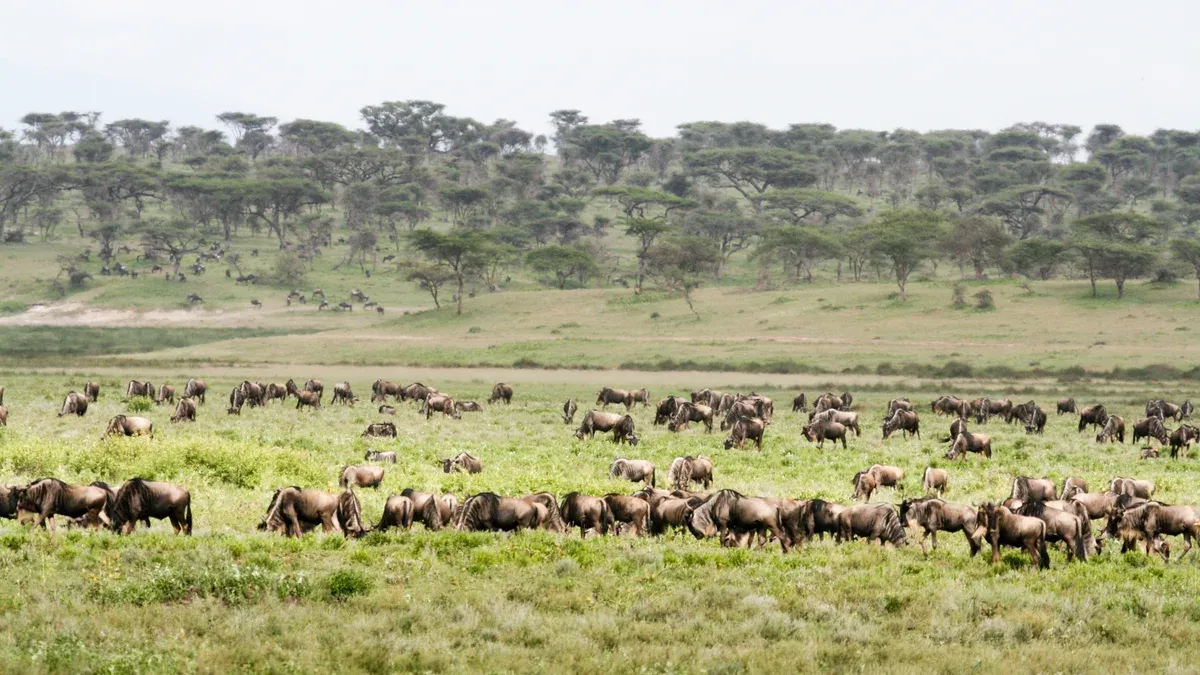
Wildebeest on the plains near Ndutu. Photo: Christoph Strässler from Oberdorf BL, Schweiz, CC BY-SA 2.0, via Wikimedia Commons
Quick answer Ndutu in short
Ndutu is a lake and short-grass plain area in the Ngorongoro Conservation Area on the edge of the southern Serengeti, about 280 km and roughly six hours by road from Arusha. In February, around 500,000 wildebeest calves are born there within two to three weeks. Peak calving draws lions, cheetahs, leopards and hyenas. The balloon operator flies from Ndutu from 20 December to 31 March.
Key takeaways
- Calving usually runs January to March, with up to 8,000 calves born per day at peak, so the best time to visit the Serengeti for newborns is these months.
- The 5-Day Serengeti Camping Safari covers Tarangire, the Serengeti and the Ngorongoro area from $1,320 per person with all fees and taxes listed as included.
- The 3-Day Serengeti Big Five Safari routes through the Ngorongoro Conservation Area with all park fees, entry, transit, concession and camping, listed as included at $900 per person.
- Compare the full range of Serengeti safari tours in the site comparison table before you book.
Where Ndutu Is
Ndutu sits where the Ngorongoro Conservation Area meets the southern Serengeti. Two sources describe its position slightly differently, so both are given here.
Location and Size
Wild Wings Safaris places Ndutu in the northern part of the Ngorongoro Conservation Area, forming its northwestern section and joining the Serengeti. Wikipedia's Lake Ndutu article instead places the lake in the southern Serengeti. The sources disagree on which side of the boundary the lake falls. The NCAA itself lists the Ndutu Plains among the notable sites of the conservation area, beside the three craters, Olduvai Gorge and the Laetoli footprints.
The figures below come from Wild Wings Safaris, Wikipedia and Roadtrip Africa. Where two sources disagree, both appear.
| Fact | Figure | Source |
|---|---|---|
| Road distance, Arusha to Ndutu | about 280 km, roughly six hours | Wild Wings Safaris |
| Flight time, Arusha to Ndutu airstrip | just under one hour | Wild Wings Safaris |
| Distance, Naabi Hill Gate to Ndutu | 30 km, about 1.5 hours | Roadtrip Africa |
| Ngorongoro Conservation Area size | 8,292 km², established 1959 | Wikipedia |
| Lake Masek position | just southeast of Lake Ndutu | Wikipedia |
| Olduvai Gorge position | 25 km downstream of Lake Ndutu and Lake Masek | Wikipedia |
Lake Ndutu, Lake Masek and the Short-Grass Plains
Lake Ndutu is a small seasonal soda lake that sometimes dries completely. Wikipedia says it recedes mainly south and east in the dry season, leaving mud flats. Lake Masek lies just southeast of it. One stream links the two lakes in wet years, and both feed the ephemeral Oldupai River. The lake and the surrounding short-grass plains form the stage for the calving season.
The soils here matter as much as the water. Eos reports that ash from Ol Doinyo Lengai, about 50 km east of the park, is rich in sodium and calcium and enriches the southeastern soils. A geoscientist quoted by Eos suspects this soil chemistry, as well as rain, steers the migration, while calling the results preliminary. Olduvai Gorge lies 25 km downstream of the two lakes, and it has its own entry fee of $35.40 per non-East African adult on the NCAA tariff.
Sources: Wild Wings Safaris, Wikipedia, Lake Ndutu, Roadtrip Africa, Eos, Ngorongoro Conservation Area Authority tariffs
Calving Season
The calving season is the reason most visitors come to Ndutu. The sources agree on the peak month and the scale, less so on the exact edges of the window.
When the Calves Are Born
Wikipedia says calving begins around January to March, with about 500,000 calves born in roughly two to three weeks in February. African Overland Tours gives the same peak: February, around 500,000 wildebeest calves within two to three weeks. Duma Explorer puts the daily peak at up to 8,000 calves born per day. Africa Geographic concentrates the births around Ndutu and the southern Serengeti in February, and notes that early calving sometimes starts in late December.
The wider window is disputed. Wild Wings Safaris says the herds settle on the Ndutu plains from about November to March or April, and that calving runs from December through May. Wikipedia's Lake Ndutu article says the gathering and calving ground is usually January to March. Wikipedia's Ngorongoro Conservation Area article says the migration arrives in December and leaves in June, which is the window the area is busiest. The blue wildebeest article adds that 80 to 90 percent of calves are born within a three-week period, that a calf weighs about 19 kg at birth and usually stands within minutes. All of it moves with the rain. African Overland Tours states plainly that migration timings are an expert estimate and not a guarantee, because rainfall drives the herds.
Predators and Numbers on the Plains
Wikipedia lists the predators around Lake Ndutu as hyenas, cheetahs, leopards and lions. With half a million newborn calves on open short grass in a few weeks, these hunters are at their most active, and Roadtrip Africa notes that predator activity peaks with the births. No sighting is ever promised.
The herds themselves are large. Wikipedia's Serengeti article gives 1.7 million wildebeest and 260,000 zebras, while the Serengeti National Park article gives more than 1.5 million wildebeest and about 250,000 plains zebra. Duma Explorer gives over 1.5 million wildebeest, around 250,000 zebras and approximately 300,000 gazelles. Wildebeest density in the Serengeti and Ngorongoro Crater reaches 35 per km². Not every calf survives: Wikipedia says 80 percent of calves in large female herds make it through the first month, against 50 percent in smaller herds.
Where the Herds Go Next
The herds stay on the plains as long as the grass lasts. Africa Geographic says in March they shift from calving to mating and start drifting north, then in April move north and west through Seronera and the Moru Kopjes as the long rains start. Duma Explorer places them in the central Serengeti in April and May. By June most are at the Grumeti River, and by July the vanguard reaches the Mara River. That part of the story belongs to the Great Migration Serengeti guide, which follows the loop month by month.
The return completes the cycle. African Overland Tours says in December the herds come back to the southern Serengeti and the Ndutu region, closing the year where it started. Duma Explorer notes that exact timing changes each year but the general pattern stays consistent, and Duma Explorer also states that no operator can guarantee where the animals will be on any given day.
Ndutu Serengeti: Should Calving Season Be on Your Bucket List?
Ndutu's calving season plains and whether it suits your trip. Third-party video by Pangolin Wildlife Photography. This site did not shoot it and has no relationship with the creator.
Fees, Rules and Getting There
Wild Wings Safaris places Ndutu in the Ngorongoro Conservation Area, so NCAA fees and rules apply. Wikipedia places the lake in the southern Serengeti, so the Serengeti fee is shown too.
Which Fees Apply
The clearest Ndutu-specific fee on the NCAA tariff is the concession fee: 59.00 per person aged 16 and over for lodge or tented camp stays, which applies to lodges in the Ndutu part of the conservation area. Olduvai Gorge entry on the same tariff is $35.40 per non-East African adult and $11.80 per child aged 5 to 15.
The NCAA tariff lists a Ngorongoro entry permit of USD 70.80 for non-East African adults aged 16 and over and USD 23.60 for children aged 5 to 15, valid for one entry within 24 hours. The Serengeti conservation fee, which applies inside the national park, differs between sources. The TANAPA tariff read via a hosted copy gives $70 peak and $60 low season per adult non-East African, VAT exclusive. Duma Explorer gives $82.60 high season and $70.80 low season, or $83 flat, including 18 percent VAT. Sources differ on whether VAT is included. Ask your operator which figure your price uses. Not every package lists park fees, so check before booking: the 3-Day Serengeti Big Five Safari at $900 per person lists all park fees including the concession fee, while the listing for the 4-Day Serengeti Mid-Range Safari at $1,750 per person does not state whether park fees are in the price, and you should ask the operator. For the full fee table, see the cost section of Serengeti safaris. The NCAA tariff page prints the concession fee as 59.00 with no currency sign, so confirm the currency with the lodge.
| Fee | Figure | Source |
|---|---|---|
| NCA concession fee, lodge or tented camp stays | 59.00 per person 16 and over | NCAA tariff |
| Olduvai Gorge entry, adult non-East African | $35.40 | NCAA tariff |
| Olduvai Gorge entry, child 5 to 15 | $11.80 | NCAA tariff |
| Serengeti conservation fee, adult | $70 peak / $60 low, VAT exclusive | TANAPA tariff via hosted copy |
| Serengeti conservation fee, adult | $82.60 high / $70.80 low, incl. 18% VAT | Duma Explorer |
Off-Road Rules
The off-road question at Ndutu has two answers, and the conflict is real. The NCAA regulations say vehicles must stay on authorised roads and tracks, and off-road driving is not allowed across the conservation area. They also set a 25 km/h speed limit and allow no more than five vehicles at one animal or kill. Altezza Travel confirms the 25 km/h maximum for the conservation area.
Operators tell a different story. Some report that guides may leave the track in the NCAA part of Ndutu, and one operator page claims off-road driving is allowed there. This conflicts with the written regulations. The safe position: the rules say stay on the tracks, ask your operator in writing what its guides actually do at Ndutu.
Where to Stay and How to Arrive
Wild Wings Safaris names Lake Masek Tented Camp and Ndutu Safari Lodge as the lodging in the Ndutu area.
By road it is about 280 km from Arusha, roughly six hours, per Wild Wings Safaris. By air, the flight from Arusha to the Ndutu airstrip takes just under an hour, and Wild Wings Safaris also lists the Seronera and Kusini airstrips. From Naabi Hill Gate, Roadtrip Africa measures 30 km and about 1.5 hours of driving.
Three catalog packages route through the Ngorongoro Conservation Area. The 3-Day Serengeti Big Five Safari at $900 per person includes all park fees and camps at Simba public campsite in Ngorongoro. The 3-Day Serengeti Safari with Balloon at $900 per person adds an optional balloon flight on day two, with park fees included and the balloon price not shown on the page. The 4-Day Serengeti Camping Safari at $950 per person includes entrance fees and camps two nights in the Serengeti and one at Ngorongoro A campsite. None of these itineraries names Ndutu itself, so confirm the routing with the operator before booking a calving-season trip.
The Balloon at Ndutu
Serengeti Balloon Safaris lists Ndutu as a launch area from 20 December to 31 March, matching the calving season. Central Serengeti flies year-round, and the listing's option descriptions give 15 May to 15 October for the Western Corridor and 15 June to 15 January for North Serengeti. So the Ndutu launch is only an option inside that window.
The standalone Serengeti Balloon Safari costs $599 per person, lists launch areas at Seronera, Kogatende, Ndutu and Kirawira, takes 5 hours, has a minimum age of 7 and does not include park admission. If a balloon over the herds is the reason for your trip, ask the operator which launch area your date uses.
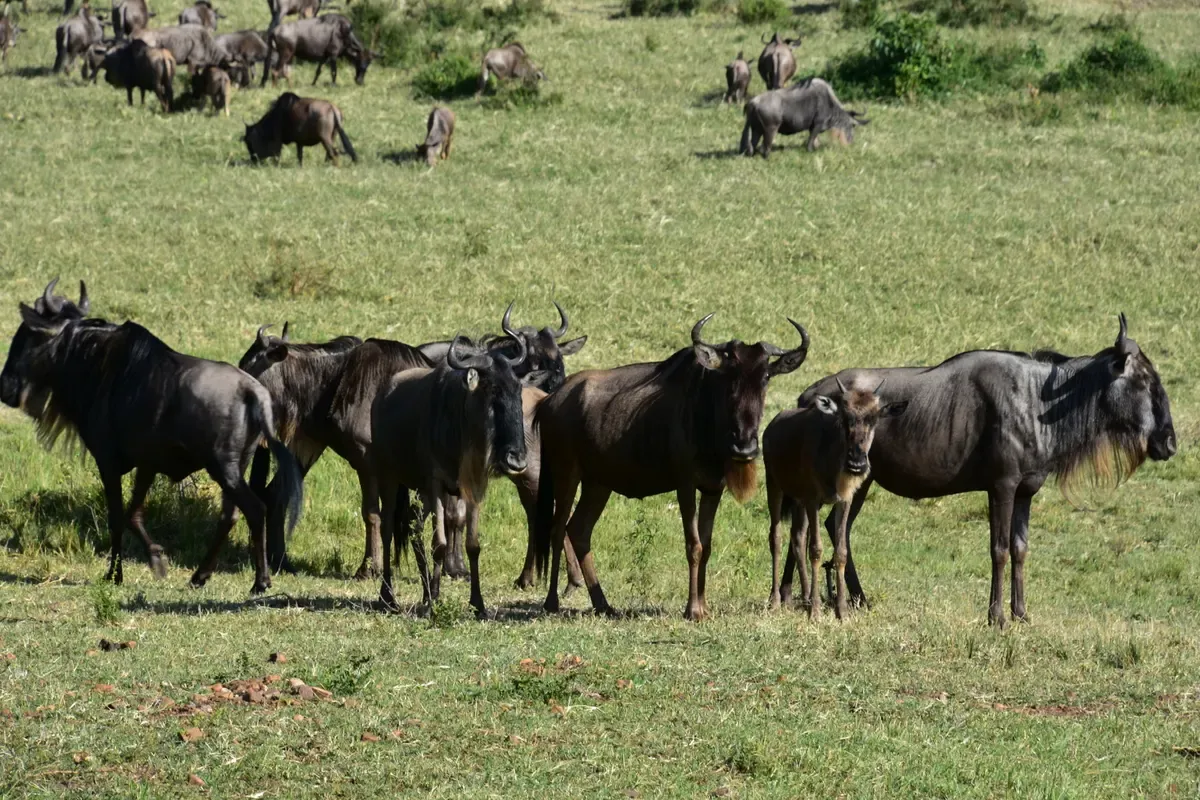
Blue wildebeest on the Serengeti plains. Photo: Richard Mortel from Riyadh, Saudi Arabia, CC BY 2.0, via Wikimedia Commons
Do and Don't at Ndutu
Do
- Do travel between late December and March, because Wikipedia and Africa Geographic both place the herds and the calving on the Ndutu plains in that window, and it moves with the rain.
- Do stay at Lake Masek Tented Camp or Ndutu Safari Lodge, because Wild Wings Safaris names them as the area's lodging.
- Do budget the 59.00 per person concession fee for your camp stay, because the NCAA tariff applies it to lodge and tented camp nights in the Ndutu part of the conservation area.
- Do ask your operator in writing whether park fees are included, because listings such as the 4-Day Serengeti Mid-Range Safari at $1,750 do not state it and the fee sources disagree on the Serengeti conservation fee.
- Do plan a balloon for 20 December to 31 March if Ndutu is the goal, because Serengeti Balloon Safaris only launches from Ndutu inside that window.
Don't
- Don't assume off-road driving is allowed at Ndutu, because the NCAA regulations say vehicles must stay on authorised roads even though some operators report guides leaving the track there.
- Don't drive fast between sightings, because the NCAA sets a 25 km/h speed limit across the conservation area.
- Don't crowd a kill site, because the NCAA rules allow no more than five vehicles at one animal or kill.
- Don't book a calving trip on dates alone, because African Overland Tours states the timings are an estimate and Duma Explorer says rainfall drives the herds and no sighting can be promised.
Ndutu FAQ
Where exactly is Ndutu?
Wild Wings Safaris places Ndutu in the northwestern section of the Ngorongoro Conservation Area, joining the Serengeti, while Wikipedia's Lake Ndutu article places the lake in the southern Serengeti. The sources disagree on the boundary. See the location table above or the Serengeti National Park guide for the park side of the line.
When is the Ndutu calving season?
Wikipedia gives January to March with about 500,000 calves in two to three weeks in February, while Wild Wings Safaris says calving on the plains runs December through May. Wikipedia and African Overland Tours both give February as the peak month. The month-by-month detail is in the Great Migration Serengeti guide.
How do I get to Ndutu from Arusha?
By road it is about 280 km and roughly six hours per Wild Wings Safaris, and by air the flight to the Ndutu airstrip takes just under an hour. Driving options and routes are covered in the getting-there section of Serengeti safari packages.
Can you drive off-road at Ndutu?
The written NCAA regulations say vehicles must stay on authorised roads and off-road driving is not allowed, while some operators report guides leaving the track in the NCAA part of Ndutu. The rules also set a 25 km/h limit. Ask the operator of your chosen trip in writing, for example the 5-Day Serengeti Ngorongoro Safari, a private trip from Kilimanjaro Airport at $2,845 per person.
Which lodges and camps are at Ndutu?
Wild Wings Safaris names Lake Masek Tented Camp and Ndutu Safari Lodge as the lodging in the area, and the NCAA tariff adds a 59.00 per person concession fee for such stays. Compare lodge-based itineraries in the styles section of Serengeti safari tours.
Is the balloon available at Ndutu?
Serengeti Balloon Safaris launches from Ndutu from 20 December to 31 March, matching the calving season. The standalone Serengeti Balloon Safari costs $599 per person with park admission not included.