 Serengeti Safari Packages
Serengeti National Park: the Complete Guide to Tanzania's Best-Known Park
Serengeti National Park in northern Tanzania is the country's first national park, covering about 14,763 km² of grassland, woodland and granite kopjes. This guide explains what the Serengeti is, where it sits, how it was created, how it is divided into four regions, what the park rules and fees are, how to get there from Arusha and where you can sleep inside the park. This guide compares it only as a place. If you want the herds month by month, read the Great Migration Serengeti guide, and for trip prices the Serengeti safari packages homepage holds the comparison table.
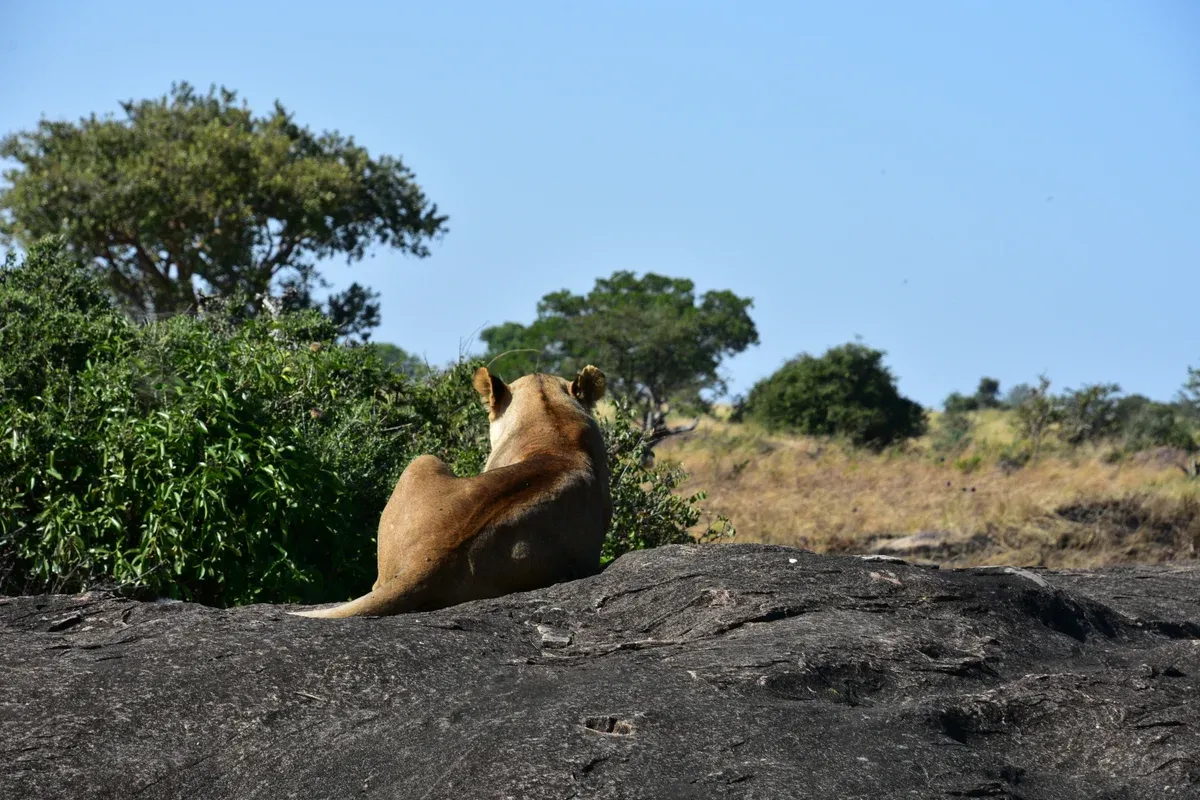
A lioness on a Serengeti kopje. Photo: Richard Mortel from Riyadh, Saudi Arabia, CC BY 2.0, via Wikimedia Commons
Quick answer The park at a glance
Serengeti National Park is a 14,763 km² national park in northern Tanzania, established in 1940 with boundaries finalized in 1951 and a UNESCO World Heritage Site since 1981. It sits about 325 to 335 km from Arusha, a drive of 6 to 8 hours by one operator's estimate (another says 9 to 10) or a flight of 1 to 1.5 hours. Most self-drive visitors enter through Naabi Hill Gate, and Seronera is the main settlement.
Key takeaways
- See how the four regions compare in the table under the regions of the park.
- The non-resident entry fee is a 24-hour permit, with sources quoting $70 or $83 for adults, set out under gates, rules and fees.
- Camping trips such as the 5-Day Serengeti Camping Safari sleep at the Seronera campsite inside the park.
- For lodge comfort, the 4-Day Serengeti Mid-Range Safari spends a night at Tanzania Bush Camp in the Serengeti.
What and Where the Serengeti Is
The Serengeti is Tanzania's flagship park and the anchor of a much wider protected ecosystem that crosses into Kenya.
The Key Figures
The table pulls together the basic figures for Serengeti National Park and names where each one comes from. Note that even the area is disputed: the same Wikipedia article carries two numbers, and SafariBookings repeats the larger one. Elevation ranges differ by source too, which tells you the park spans a big vertical range from plains to hills.
Distances are road distances from Arusha, the usual starting point for Serengeti safari packages.
| Fact | Figure | Source |
|---|---|---|
| Area | 14,763 km² (Wikipedia infobox and SafariBookings) vs 14,750 km² (Wikipedia Geography section) | Wikipedia, SafariBookings |
| Established as a park | 1940, boundaries finalized 1951 | Wikipedia |
| UNESCO World Heritage Site | 1981, reference 156, criteria vii and x | Wikipedia |
| IUCN category | Category II | Wikipedia |
| Elevation | 920 to 1,850 m (Wikipedia) vs 1,140 to 2,099 m (SafariBookings) | Wikipedia, SafariBookings |
| Distance from Arusha | About 325 to 335 km to Seronera | Foot Slopes Tours |
| Visitors | About 350,000 a year | Wikipedia |
The Name and the History
The name Serengeti is usually traced to the Maasai word siringet, rendered as "the place where the land runs on forever" or "endless plains". Wikipedia flags the derivation as dubious and notes the word does not appear in Maasai dictionaries, so treat the translation as tradition rather than settled fact.
The protected history starts with the Tanganyika government creating the Serengeti Game Reserve on 19 November 1929, after a game warden was posted there in July 1929. Easy Travel dates a 2,286 km² reserve to 1930 in what is now the southern and eastern Serengeti, and says sport hunting was allowed until 1937. Major Richard Hingston proposed national park status in 1930. The area became a park in 1940, strict protection began in 1948 with the Serengeti National Park Board of Trustees, and the park was chartered in 1951 as Tanganyika's first national park.
In 1959 about 8,300 km² in the east was split off to form the Ngorongoro Conservation Area, removing Ngorongoro Crater, Olduvai Gorge and the Salei Plains, roughly half the original park. The film Serengeti Shall Not Die, written and directed by Bernhard Grzimek, premiered on 25 June 1959, runs 85 minutes and won the Academy Award for Best Documentary Feature. Michael Grzimek died on 10 January 1959 when his Dornier Do 27 crashed over the Ngorongoro Crater while surveying the ecosystem. The Serengeti Research Institute was established at Seronera in 1966, and the rebuilt Serengeti Visitor Centre at Seronera was opened on 7 October at a cost of TZS 3.9 billion, financed by Germany through BMZ and KfW Development Bank and implemented by TANAPA with the Frankfurt Zoological Society.
The Wider Ecosystem
The park is the core of a protected area of roughly 30,000 km² that Wikipedia says now holds 60% of its original size because of human encroachment, with Tanzania and Kenya protecting over 80% of what remains. To the north, the 1,510 km² Maasai Mara National Reserve in Kenya is contiguous with the park, and the two together form a Lion Conservation Unit established in 2005. To the southeast lies the Ngorongoro Conservation Area, split off from the park in 1959.
To the west sit Ikorongo and Grumeti Game Reserves, with Grumeti covering 411.89 km² and dating from 1993, and Maswa Game Reserve lies to the southwest. The Loliondo Game Control Area borders the northeast and east. Human habitation inside the park is banned except for park staff, researchers and lodge, campsite and hotel staff.
Between 2005 and 2012 the government considered a 452 km highway through the park and revived the plan in 2024. The Mara River is the only permanently flowing river in the whole ecosystem, and SafariBookings puts the migration loop across it at about 800 km, while Eos gives roughly 500 km a year.
Sources: EBSCO, Easy Travel, Daily News
The Four Regions of the Park
Most itineraries divide the park into four practical regions. The table below sets out the landscape of each, the months sources highlight, and named places to sleep from the facts only.
The Regions Compared
Seronera in the central Serengeti is the main settlement and holds the primary Seronera airstrip, so it is the base for most Serengeti safari packages. The southern plains are almost treeless grassland, with Ndutu inside the Ngorongoro Conservation Area on the park's edge. The Western Corridor follows the Grumeti and Mbalageti rivers, flatter and denser in plant cover than the south, with riverine forest and small mountain ranges.
The northern Serengeti runs from Seronera to the Mara River on the Kenyan border through open Commiphora woodland and hills, which Wikipedia calls remote and relatively inaccessible. SafariBookings names January to February and June to October as the best months overall, and Expert Africa notes game viewing at Ndutu is strongest December to March while June to October brings far fewer vehicles there.
| Region | Landscape | Best months | Sleep at |
|---|---|---|---|
| Seronera (central) | Main settlement, primary airstrip, mixed grassland and woodland | January to February and June to October (SafariBookings, park-wide) | Seronera Wildlife Lodge (78 rooms), Serengeti Serena Safari Lodge (66 rooms), Tanzania Bush Camp, Enkirari Wilderness Camp |
| South and Ndutu | Almost treeless grassland plains, Lake Ndutu a seasonal soda lake that can dry fully | December to March (Expert Africa at Ndutu Safari Lodge) | Ndutu Safari Lodge (34 cottages, inside NCA) |
| Western Corridor | Grumeti and Mbalageti rivers, riverine forest, small mountain ranges | Herds pass April to May or May to July, sources conflict (Wikipedia) | Grumeti Game Reserve on the park's northwestern border |
| North and Kogatende | Commiphora woodland and hills to the Mara River, remote | No region-specific months given, park-wide best months are January to February and June to October (SafariBookings) | Lamai Serengeti (12 rooms on Kogakuria Kopje), Sayari Camp (15 tents, 9 km from Kogatende Airstrip), Heritage Mara Camp |
The Kopjes
Kopjes are granite outcrops that rise from the plains, and Wikipedia describes them in the southern Serengeti as observation posts for predators. They are among the park's signature habitats, listed by Wikipedia alongside riverine forests, swamps, grasslands and woodlands. The Moru Kopjes shelter the Serengeti's only black rhino sanctuary with 19 animals tracked by the Serengeti Rhino Project, which keeps a small visitor centre there.
A short walk up the Moru granite leads to Maasai rock paintings in clay and ash showing shields, elephants and people, and to Gong Rock, a boulder with hollows that ring when struck. Further north, Lamai Serengeti sits on the Kogakuria Kopje, and Four Seasons Safari Lodge Serengeti is built on a kopje next to a waterhole in the central Serengeti. Note that a special rhino viewing at Moru costs $100 per trip under the TANAPA tariff.
The Truth About a Serengeti Safari (5 Things You Should Know)
A guide to what a Serengeti safari is really like, with five points to know before booking. Third-party video by Ella McKendrick. This site did not shoot it and has no relationship with the creator.
Gates, Hours, Rules and Fees
Entry is by permit bought per 24 hours, and sources disagree on the adult figure because of VAT. The table gives both sides and the rules follow.
Fees Per 24 Hours
Every figure below is per adult unless stated. The core conflict is VAT. The TANAPA tariff read here quotes the non-East African adult conservation fee as $70 in peak season and $60 in low season, VAT exclusive, while Duma Explorer and SafariFind quote $82.60, $70.80 or $83 including 18% VAT.
The seasons also split differently depending on the fee: conservation fees run peak from 16 May to 14 March and low from 15 March to 15 May, while concession and campsite fees peak in July to September and drop from October to June. Children aged 5 to 15 pay child rates and under 5 is free. Fees are for multiple entry, once paid they are non-refundable, and proof of identification is mandatory at the gate.
Most self-drive visitors enter through Naabi Hill Gate, 85 km and 2 to 3 hours from the crater entrance, and permits are bought at the gate by credit card, as cash and debit cards are not accepted there per Roadtrip Africa. SafariFind says TANAPA moved to 100% digital payment at major gates in 2024.
| Fee | Amount | Source |
|---|---|---|
| Entry, non-East African adult | $70 peak / $60 low, VAT exclusive, vs $82.60 high / $70.80 low or $83 flat, VAT included | TANAPA tariff vs Duma Explorer and SafariFind |
| Entry, child 5 to 15 | $20 both seasons, vs $23.60 high / $11.80 low | TANAPA tariff vs Duma Explorer |
| Entry, East African adult | TSh 10,000 | TANAPA tariff |
| Entry, expatriate or resident adult | $35 peak / $30 low | TANAPA tariff |
| Hotel concession fee, adult | $60 per night July to September, $50 October to June, vs $71 per night (Duma) | TANAPA tariff vs Duma Explorer |
| Public campsite | $30 per adult per night, vs $35.40 (Duma) | TANAPA tariff vs Duma Explorer |
| Special or seasonal campsite | $60 per adult per night July to September, $50 October to June, vs $70.80 high / $59 low (Duma) | TANAPA tariff vs Duma Explorer |
| Premium special campsite | $300 per adult per night | TANAPA tariff |
| Guide fee | $20 per group per day | TANAPA tariff |
| Commercial foreign vehicle | $40 per day up to 2,000 kg, then $150, $200, $300 and $500 by weight band | TANAPA tariff |
| Balloon operation fee | $50 per person per trip | TANAPA tariff |
| Special rhino viewing at Moru | $100 per trip | TANAPA tariff |
| All charges | VAT (18%) exclusive per the tariff | TANAPA tariff |
The Rules Inside the Park
Game drives run from roughly 6 am to shortly after 6 pm per Altezza Travel, and moving around at night or disturbing animals at night is prohibited, which is why the Serengeti does not appear on the tariff's night game drive list, a list that covers Tarangire and Lake Manyara only. Guides do not drive off the roads laid out by the park authorities, so off-road driving is not allowed. Visitors may leave the vehicle only at picnic sites, observation areas and walking safari routes. Feeding animals is prohibited and campfires are not allowed.
Speed limits conflict by source: Altezza Travel gives 50 km/h in national parks, while Roadtrip Africa gives 25 to 40 km/h depending on road conditions and park. The B144 from Seronera to Naabi Hill Gate is rocky and badly corrugated and should be driven below 25 km/h per Roadtrip Africa. A TANAPA ranger for self-drive visitors costs about $40 a day plus a tip, is arranged at the gate and cannot drive your vehicle. The tariff sets a fine of TSh 200,000 for vehicles causing an accident in national parks, and open vehicles pay 50% extra on the vehicle entry fee.
Sources: TANAPA tariff, Duma Explorer, SafariFind.
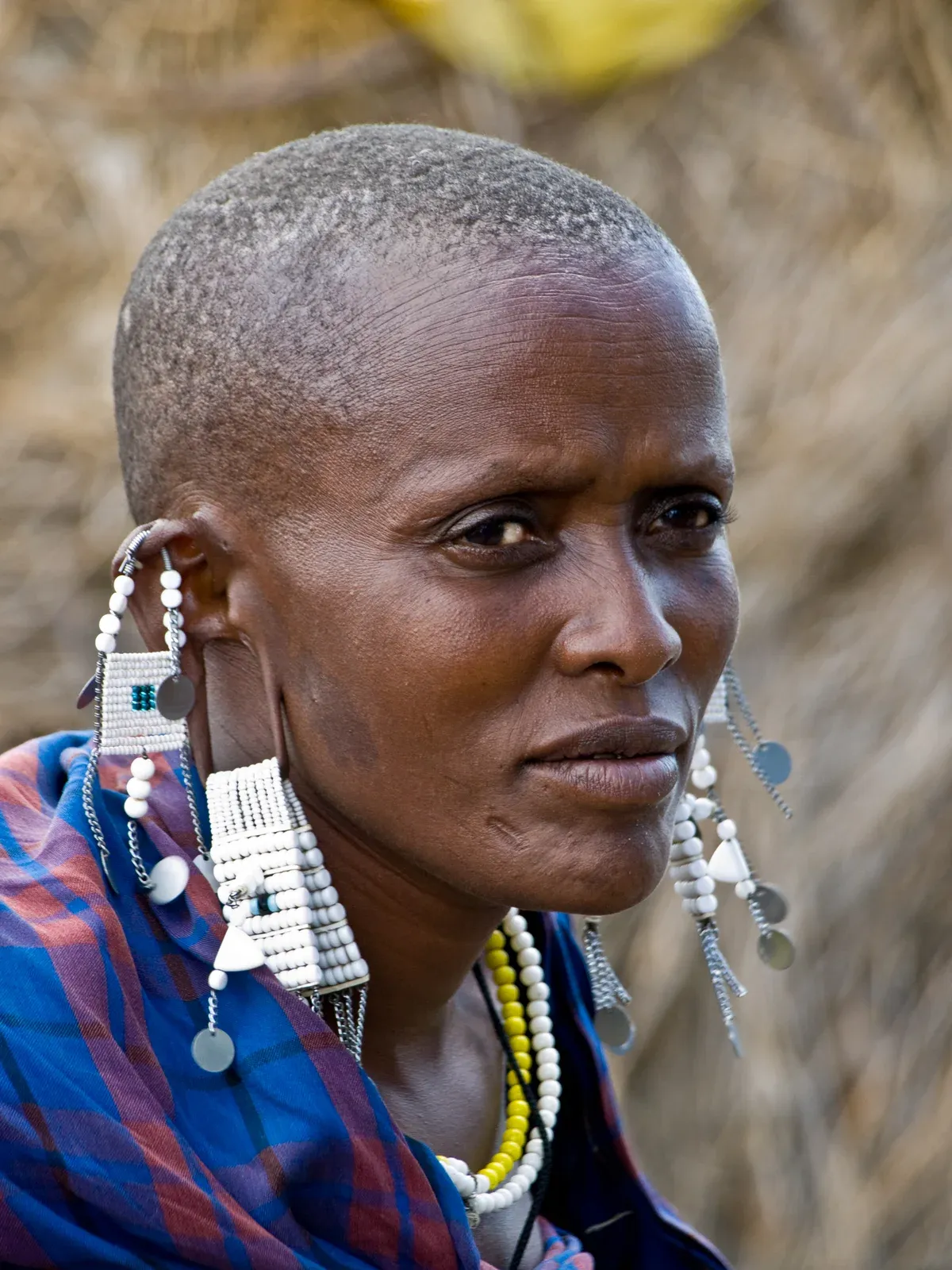
A Maasai woman in traditional beadwork. Photo: William Warby from London, England, CC BY 2.0, via Wikimedia Commons
Getting There and Where to Sleep
Arusha is the launch point for almost every overland trip. You can drive, fly, or fly in from Zanzibar, and you can sleep inside the park at lodges, camps or campsites.
By Road
Foot Slopes Tours puts Arusha to central Serengeti at approximately 325 to 335 km and says the drive typically takes 6 to 8 hours depending on weather and entry gate, advising a start between 6:00 and 7:00 AM. Roadtrip Africa is more cautious, saying Seronera to Arusha takes 9 to 10 hours and advising against doing it in one day. Expert Africa puts Serengeti Serena Safari Lodge about 340 km from Arusha, roughly 8 to 10 hours by road.
The usual route breaks at Karatu, 140 km and about 3.5 hours from Arusha. Karatu holds the last fuel station before the Serengeti, though Seronera has an emergency station with higher prices. From the crater entrance, Naabi Hill Gate is 85 km and 2 to 3 hours, Naabi Hill Gate to Seronera is 60 km and about 1 hour, and Seronera to the Lobo ranger post is 80 km and about 2 hours. Roadtrip Africa warns the road from Naabi Hill Gate to Seronera is bumpy with washboard surfaces, and some areas are only allowed with a Toyota Land Cruiser.
By Air
A fly-in from Arusha or Kilimanjaro airport takes approximately 1 to 1.5 hours per Foot Slopes Tours, or about 60 minutes by air to Serengeti Serena per Expert Africa. Auric Air lists eight Serengeti airstrips with codes: Seronera (SEU), Kogatende (KOG), Lamai Triangle (LAM), Sasakwa (SAS), Grumeti (GTZ), Fort Ikoma (FTI), Lobo (LOB) and Ndutu (NTU). Seronera Wildlife Lodge is 2 km, a five-minute drive, from the Seronera airstrip, and Sayari Camp is 9 km, a 15 to 20 minute drive, from Kogatende Airstrip.
If you want to skip the road entirely, the Serengeti Fly-In Safari has a scheduled flight to the Serengeti on day 1 for $2,750.77 per person (the inclusions do not name the flight, so confirm it is in the price), and the Zanzibar to Serengeti Safari flies return from Zanzibar to Seronera for $1,875 per person with one night at Africa Safari Serengeti Ikoma near the gate.
Sleeping Inside the Park
Named inside the park or on its edge: Seronera Wildlife Lodge with 78 rooms and a swimming pool carved into a rock outcrop, Serengeti Serena Safari Lodge with 66 rooms in the Kyabatero Hills 27 km from the airstrip, Four Seasons Safari Lodge Serengeti with 77 units about 25 km north of Seronera and 90 minutes by road from the airstrip, Lamai Serengeti and Sayari Camp in the far north, and Ndutu Safari Lodge with 34 cottages inside the Ngorongoro Conservation Area. Serengeti Under Canvas moves two camps of nine guest tents each with the seasons: Ndutu from before Christmas to early April, Seronera from early April to the end of May, Grumeti June to mid-July, Kogatende mid-July to early November, then Seronera again early November to mid-December.
Several bookable trips sleep at the Seronera campsite inside the park. The 5-Day Serengeti Camping Safari at $1,320 per person spends 2 nights at Seronera campsite and lists all fees and taxes as included. The 3-Day Serengeti Big Five Safari at $900 per person camps at Tumbili public campsite with all park fees included. The 4-Day Serengeti Camping Safari at $950 per person includes 2 Serengeti campsite nights and entrance fees. Lodge trips sleep inside too: the 3-Day Private Serengeti Safari uses Enkirari Wilderness Camp in the central Serengeti, and the 8-Day Serengeti Migration Safari spends 2 nights at Heritage Mara Camp in the northern Serengeti.
Sources: Auric Air, Foot Slopes Tours
Dos and Don'ts in the Serengeti
Simple habits that keep the trip legal, comfortable and on budget, all drawn from the sources on this page.
Do
- Do plan 3 to 5 days in the park, because Foot Slopes Tours recommends at least that long to experience the Serengeti and the road alone eats 6 to 8 hours each way from Arusha.
- Do carry a credit card for gate permits, because Roadtrip Africa says cash and debit cards are not accepted at the gate and permits are bought there by credit card.
- Do carry proof of identification, because the TANAPA tariff makes proof of identification mandatory at the entry gate.
- Do book campsites ahead for seasonal sites, because the TANAPA tariff states prior booking is required for Serengeti seasonal campsites.
- Do leave Arusha between 6:00 and 7:00 AM on driving days, because Foot Slopes Tours suggests that start time for the long road transfer.
Don't
- Don't drive off the tracks, because Altezza Travel says guides do not leave the roads laid out by the park authorities.
- Don't plan night drives or campfires in the park, because night movement and disturbing animals at night is prohibited and campfires are not allowed, which is why the tariff lists night drives only at Tarangire and Lake Manyara.
- Don't speed, because limits are 50 km/h per Altezza Travel or 25 to 40 km/h per Roadtrip Africa, and the corrugated B144 should be driven below 25 km/h, with a TSh 200,000 fine for vehicles causing an accident.
- Don't leave the vehicle outside designated spots, because Altezza Travel allows leaving the vehicle only at picnic sites, observation areas and walking safari routes.
Where to Stay in and Around the Serengeti
Each link opens the live room list for that place on the booking site, with today's prices. Most packages include their nights, so these links are for the nights before and after a trip, or for a self-arranged stay.
Seronera, central Serengeti
- Suits
- Lodges and tented camps in the middle of the park
Seronera is where most road packages sleep and where the main airstrip is.
See stays in Seronera, central SerengetiArusha
- Suits
- Hotels for the night before pickup and the night after the safari
Most packages in the catalog start and end in Arusha.
See stays in ArushaKaratu
- Suits
- Lodges between Lake Manyara and the Ngorongoro Crater
Several lodge packages spend a night in Karatu on the way in or out.
See stays in KaratuSerengeti National Park: Questions and Answers
What is special about Serengeti National Park?
It is Tanzania's first national park, chartered in 1951, a UNESCO World Heritage Site since 1981, and it holds roughly 70 large mammal species and more than 500 bird species across 14,763 km². More than 3,000 lions live in the wider Serengeti and Maasai Mara ecosystem per Wikipedia. See which species to expect in the Serengeti animals guide.
Where is the Serengeti?
Serengeti National Park sits in northern Tanzania, about 325 to 335 km from Arusha, bordered by the Maasai Mara in Kenya to the north and the Ngorongoro Conservation Area to the southeast. Most trips start in Arusha, as the Serengeti safari packages comparison shows.
How much is a Serengeti tour?
Bookable group camping trips start from $770 per person for 3 days in the catalog on this site, a mid-range 4-day lodge safari runs $1,750 per person, and a private 5-day safari costs $2,845 per person. Park fees are not always included, so check each listing. The full breakdown sits in the comparison table.
How much are Serengeti park fees?
The non-East African adult conservation fee is $70 in peak season and $60 in low season, VAT exclusive, per the TANAPA tariff, while Duma Explorer and SafariFind quote $82.60, $70.80 or $83 including 18% VAT, paid as a single 24-hour permit. Children 5 to 15 pay less and under 5 is free. Details are under gates, rules and fees.
How long does it take to get to the Serengeti from Arusha?
By road the trip takes 6 to 8 hours per Foot Slopes Tours, though Roadtrip Africa puts Seronera to Arusha at 9 to 10 hours and advises against one day. Flying takes about 1 to 1.5 hours. Both options are compared under getting there.
When is the best time to visit Serengeti National Park?
SafariBookings and Roadtrip Africa both name January to February and June to October as the best months, with the dry season running June to October and the wet season November to May. How the seasons shape a trip is explained in the best time to visit Serengeti guide.